Good News
The Dark Sky Dividend
Lighting codes do not leave a residue. Where the lamp is actually turned down, the night’s users show up on the clock of the cue.
The night does not have a half-life. A pesticide in sediment does. A dam’s missing sand does. Lead in a condor does. Photons stop when the switch is thrown. That is the whole dividend, and it is why a lighting ordinance is a different kind of environmental law from the ones that have to wait on chemistry.
The civic slogan is larger than the ledger, and it should be named as such. Towns that adopt strict outdoor-lighting codes are not, as a class, publishing rapid, town-wide insect censuses that rebound on a season’s clock. That sentence is not yet a finding. What is a finding is narrower and, in Flying River’s sense, better: where light is actually removed, shielded, or switched off, the animals that were using the dark respond on the timescale of the cue. Migrating birds can leave a beam in twenty minutes. Moths at a fixture stop dying against it the night the fixture goes dark. Caterpillars are more abundant in unlit hedges than in matched lit ones. A city that budgets lumens the way it budgets water can keep a sky ninety percent fainter than a peer city that does not. The repair is real. It is just not a single graph labeled “the town.”
A city that treated darkness as a budget
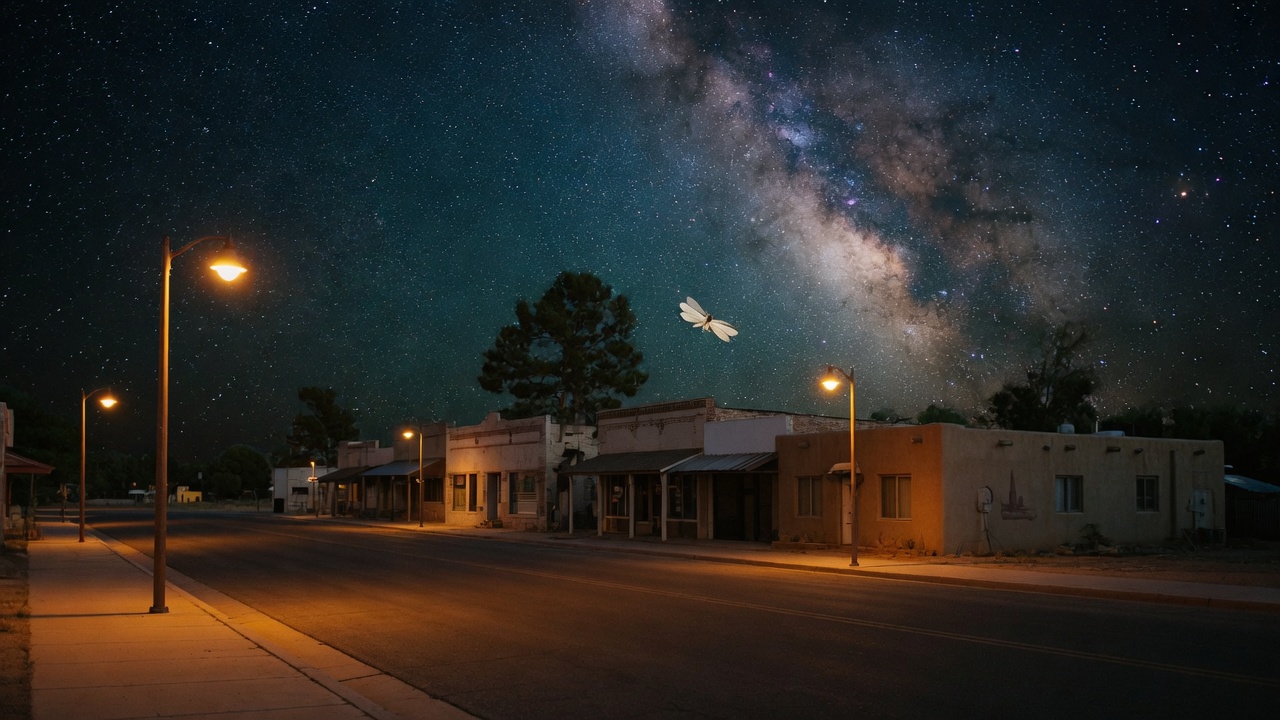
Flagstaff, Arizona, did not set out to save moths. In 1958 the city council passed Ordinance 400, banning commercial searchlights, after astronomers at Lowell Observatory objected to a civic habit of welcoming new businesses with beams in the sky. It was the first outdoor lighting ordinance anywhere in the world. The constituency was telescopes. The later beneficiaries were everything else that still had to use the night.
The 1958 rule was a beginning, not a night. In 1972 Flagstaff required outdoor lights to be shielded and aimed down. In 1989 the city and Coconino County capped the total amount of light permitted per acre, zone by zone: darkness as a rationed public resource, not as leftover gloom. In 2001 DarkSky International (then the International Dark-Sky Association) named Flagstaff the world’s first International Dark Sky City. The current code still talks, in the dry language of zoning, about migrating birds and other nocturnal animals. The telescopes remain. The wildlife clause is no longer an accident.
The measurement that matters is not a plaque. In 2016, reported the following January at an American Astronomical Society meeting and in the Arizona Daily Sun, Flagstaff’s light dome was about ninety percent fainter than that of Cheyenne, Wyoming, a city of similar size without equivalent controls. The Flagstaff Dark Skies Coalition’s working summary of the method is three strategies, ranked: amber or narrowband amber for most area lighting (not merely “warm white”); fully shielded fixtures; and a nonresidential cap on the order of 35,000 lumens per acre. Their published reduction factors for those three, near the sources, are on the order of seventy, fifty, and twenty-five percent, compounding. Those percentages are engineering estimates from the lighting literature, not a biological census. They are still a demonstration that a modern city of tens of thousands can keep the Milky Way over downtown. About eighty percent of North Americans, in the 2016 world atlas of night-sky brightness by Fabio Falchi, Christopher Kyba, and colleagues, cannot.
Tucson’s 1972 ordinance, written in part for Kitt Peak, is the same family of law. Christopher Kyba has pointed to well-designed LED retrofits there as a case where emissions can fall without a public sense of gloom—if the energy savings are not spent on new light. The 2012–2016 satellite record, also Kyba’s group, found Earth’s artificially lit outdoor area growing about 2.2 percent per year. The global default is still more photons. A code is the local refusal of that default.
What the ordinance is actually doing
A lighting code is not a poem about stars. It is a specification: fully shielded fixtures that emit no light above the horizontal; a lumen budget per acre so that a parking lot cannot become a stadium; a spectrum cap so that the cheapest blue-rich LED is not the municipal default; timers and curfews so that a closed shop does not light a treetop until dawn. DarkSky International and the Illuminating Engineering Society have jointly stated five principles: useful, targeted, no brighter than necessary, controlled in time, and, where possible, warmer in colour. Those are design rules. They are also, increasingly, the grammar of municipal law.
Avalon Owens, Michael Pocock, and Brett Seymoure, reviewing insect-friendly lighting in 2024, put a useful damper on the brochure. Most studies test spectral tuning and dimming; both, in practice, often fail to deliver the conservation benefit advertised. Shielding and motion sensors look more promising and remain understudied. The least disputed intervention is still the least glamorous: take unnecessary light out of the habitat. “A preponderance of evidence,” they wrote, “now demonstrates that removing unnecessary light sources from natural habitats can reverse their varied impacts on diverse insect taxa.” Reverse is the verb. Residual is the thing light does not leave. Owens and colleagues had already argued, in 2020, that artificial light at night is an overlooked driver of insect declines, and that it is unusual among those drivers because it can be turned down without a cleanup.
That is the scientific warrant for the ordinance, and it is not the same as a before-and-after moth count on Main Street. A code that only swaps 5000 K LEDs for 3000 K LEDs, without a lumen cap or a curfew, may satisfy an astronomy checklist and still leave the hedge as bright as a stage. Owens’s review is the reason Flying River will not treat “DarkSky-friendly bulb” as a completed repair. The repair is less light, better aimed, for fewer hours. Colour is a refinement.
Recent fixture-scale work is catching up to the shield. A 2024 Communications Biology study of tailored, shielded road lights along a German skyglow gradient found that confining the light field reduced insect attraction without violating EU road-lighting norms. A 2026 field comparison of unshielded, conventionally shielded, and recessed fixtures found that restricting illumination to about 100 degrees above nadir cut flying-insect attraction by roughly half relative to unshielded lamps; a shield that cut uplight but left glare did not. Ground-dwelling insects in pitfall traps did not follow the same pattern. The night at ankle height is not the night at lamp height. An ordinance written only for the sky can miss the hedge.
Birds, and a switch that works in minutes
Most of the songbirds that cross North America in spring and autumn fly at night. Light draws them into cities and holds them. Glass finishes the collision. Scott Loss, Tom Will, Sara Loss, and Peter Marra estimated, from twenty-three studies, that building collisions kill on the order of 365 to 988 million birds a year in the United States, with a median near 600 million. That is the background arithmetic. The good-news arithmetic is what happens when the light is edited.
In New York, Benjamin Van Doren, Kyle Horton, and colleagues used radar and acoustic sensors at the National September 11 Memorial’s Tribute in Light. Two vertical xenon beams, even in a city already bright, concentrated migrants to altitudes of four kilometres. Across seven commemorative nights they estimated that the beams influenced on the order of 1.1 million birds. Densities near the installation exceeded surrounding baseline by a factor of twenty in the observations they modelled. Birds slowed, circled, and called. When the lights were extinguished for twenty minutes, the aggregation dispersed. Twenty minutes is not a recovery plan. It is a measurement of how little lag the cue has.
Chicago’s McCormick Place, monitored at dawn for decades by Field Museum scientists, offered a longer ledger. Van Doren and colleagues, in 2021, found that nights with about half the windows darkened had on the order of eleven times fewer collisions in spring and six times fewer in autumn than nights with the building fully lit, after accounting for weather and migration volume. Cutting lighted window area in half during migration seasons could, they estimated, reduce mortality at that building by about fifty-nine percent. The birds are not a metaphor. They are a switch.
Lights Out programs—Audubon’s network, Chicago’s program since the mid-1990s, and dozens of other cities—ask building managers to extinguish decorative lighting and dim interiors during peak migration. The intervention is seasonal and cheap. It is not a full dark-sky ordinance. It is the part of the ordinance that can be run as a calendar. Communication towers are the same lesson in a different geometry. Joelle Gehring, Paul Kerlinger, and Albert Manville found that guyed towers lit with flashing beacons plus steady-burning red lights killed more night-migrating songbirds than towers lit only with flashing lights. Removing the steady-burning lamps was associated with a reduction on the order of fifty to seventy-one percent. The FAA later allowed the change. The tower stayed. The extra mortality did not have to.
Glass is the other half of the bird problem, and light reduction does not solve it. McCormick Place’s later dotted film, installed after a mass-collision night in October 2023, cut fall collisions by about ninety-five percent relative to prior seasons—a different tool, a different paper. Keep the tools apart. The dark-sky dividend for birds, strictly, is the light. The glass is a second invoice.
Insects: the slower clock, the cleaner experiment
If the bird story is a switch, the insect story is a season, and sometimes several.
Douglas Boyes, Darren Evans, Richard Fox, Mark Parsons, and Michael Pocock, in Science Advances in 2021, used a matched-pairs design along English street-lit lanes. Hedgerows under lights held about forty-seven percent fewer moth caterpillars than unlit matched hedges; grass margins, about thirty-three percent fewer. A separate experiment in habitats with no lighting history found that artificial light at night disrupted nocturnal caterpillar feeding. White LED street lights were worse than the older yellow sodium lamps. Caterpillars are not the adult moths that die on the glass. They are the local population’s next year. A songbird chick that forages a short distance from a nest is eating that next year. Boyes’s group had, in a 2021 review, also cautioned against treating light as a demonstrated driver of continental moth declines; habitat and climate remain the large terms. The hedgerow result is local, causal, and large. It is the right scale for a town.
Roy van Grunsven and colleagues ran the complementary experiment in the Netherlands: experimental illumination of otherwise dark sites, followed for years. In the first two years, moth numbers in lit and dark treatments did not differ. In the later three years, illuminated sites had about fourteen percent fewer macro-moths than dark controls, an effect that did not differ among the three spectra they tested. Latency is the finding. A town that passes a code in April should not expect a moth graph to leap in May. The same paper is why a town that keeps measuring for five years is doing the science that the slogan skipped.
What we do not yet have, in general, is the inverse experiment at municipal scale: pass a strict code, keep the traps running, publish the rebound. Owens’s 2024 review treats removal of unnecessary light as reversible for diverse insect taxa. Fixture studies show fewer insects at better-aimed lamps the night they are installed. Population studies show that adding light takes years to register. The honest interpolation is that subtracting light should work, and that “rapid” belongs to behaviour at the lamp, not to a county-level index. Pesticides, habitat loss, and climate are still in the same frame. A darker street will not restore a hedge that was grubbed out. It will stop adding a pressure that, uniquely, leaves no residue.
Eisenbeis and others have estimated that a large fraction of insects attracted to stationary lamps die before morning, by exhaustion or predation. Those deaths cease when the lamp is off. That is not a population model. It is still a dividend you can count in a trap under a fixture, which is how a public works department can tell whether a retrofit did anything besides save electricity.
What “rapid” is allowed to mean
Hope that belongs here is particular. Flagstaff’s sky is measurably darker than a peer city’s. A beam in Manhattan can be emptied of birds in the time it takes to hold a minute of silence. A convention hall on a lakeshore can cut collision mortality by more than half by darkening half its glass. A hedge without a streetlight holds more caterpillars than a hedge with one. A moth population under experimental lamps thins after a delay of years, which is also a statement about what darkness, restored, is for.
What remains unmeasured is the sentence on the brochure: that towns, as a class, see rapid recovery in local insect populations and migratory bird survival after adopting strict light-pollution laws. Survival of a migrant is a continental number. A local ordinance cannot be asked to show it. Local collision counts can. Local insect abundance can, if someone funds the traps. Most codes are still written for astronomy and glare. The wildlife clause is catching up. The monitoring is behind the clause.
That gap is not a reason to wait. It is a reason to attach a count to the next ordinance the way a recovery program attaches a studbook to a condor. Light is the rare pressure that can be reduced with a screwdriver, a spectrum, a curfew, and a lumen cap. Rebecca Steinbach and colleagues, examining switch-off, part-night lighting, and dimming in England and Wales, found little evidence that those adaptations increased night-time collisions or crime at the scales they could measure. Brandon Welsh, David Farrington, and Stephen Douglas, in a 2022 review, found street-lighting interventions associated with about a fourteen percent reduction in total crime—and a pattern that does not reduce to “brighter after dusk, fewer offences.” More lumens is not a law of safety. You can light a crosswalk and still leave the treetops to the animals that were already using them.
The hidden force is not romance. It is a specification that treats the night as occupied. The occupation was never in doubt. The news is that a city can write that fact into a zoning code, keep the sidewalk, and, where it bothers to look, watch a cue return the same night the lamp is aimed at the ground.
Sources
- Flagstaff Dark Skies Coalition. “The Flagstaff Solution.” flagstaffdarkskies.org. (Ordinance history; 2016 sky-brightness comparison with Cheyenne; amber, shielding, and lumen-cap strategies.)
- City of Flagstaff. Outdoor lighting standards; recognition as first International Dark Sky City, 24 October 2001.
- Physics Today. “Dark-sky advocates confront threats from above and below” (2022). Flagstaff 1958 searchlight ban; Tucson 1972 ordinance; Kitt Peak.
- Falchi, Fabio, Pierantonio Cinzano, Dan Duriscoe, Christopher C. M. Kyba, et al. “The New World Atlas of Artificial Night Sky Brightness.” Science Advances 2, no. 6 (2016): e1600377.
- Kyba, Christopher C. M., Theres Kuester, Alejandro Sánchez de Miguel, et al. “Artificially Lit Surface of Earth at Night Increasing in Radiance and Extent.” Science Advances 3, no. 11 (2017): e1701528.
- Owens, Avalon C. S., Précillia Cochard, Joanna Durrant, Bridgette Farnworth, Elizabeth K. Perkin, and Brett Seymoure. “Light Pollution Is a Driver of Insect Declines.” Biological Conservation 241 (2020): 108259.
- Owens, Avalon C. S., Michael J. O. Pocock, and Brett M. Seymoure. “Current Evidence in Support of Insect-Friendly Lighting Practices.” Current Opinion in Insect Science 66 (2024): 101276.
- van Grunsven, Roy H. A., et al. “Experimental Light at Night Has a Negative Long-Term Impact on Macro-Moth Populations.” Current Biology 30, no. 12 (2020): R694–R695.
- Boyes, Douglas H., Darren M. Evans, Richard Fox, Mark S. Parsons, and Michael J. O. Pocock. “Street Lighting Has Detrimental Impacts on Local Insect Populations.” Science Advances 7, no. 35 (2021): eabi8322.
- Boyes, Douglas H., et al. “Is Light Pollution Driving Moth Population Declines? A Review of Causal Mechanisms across the Life Cycle.” Insect Conservation and Diversity 14, no. 2 (2021): 167–183.
- Van Doren, Benjamin M., Kyle G. Horton, Adriaan M. Dokter, Holger Klinck, Susan B. Elbin, and Andrew Farnsworth. “High-Intensity Urban Light Installation Dramatically Alters Nocturnal Bird Migration.” Proceedings of the National Academy of Sciences 114, no. 42 (2017): 11175–11180.
- Van Doren, Benjamin M., et al. “Drivers of Fatal Bird Collisions in an Urban Center.” Proceedings of the National Academy of Sciences 118, no. 24 (2021): e2101666118.
- Loss, Scott R., Tom Will, Sara S. Loss, and Peter P. Marra. “Bird–Building Collisions in the United States: Estimates of Annual Mortality and Species Vulnerability.” The Condor 116, no. 1 (2014): 8–23.
- Gehring, Joelle, Paul Kerlinger, and Albert M. Manville II. “Communication Towers, Lights, and Birds: Successful Methods of Reducing the Frequency of Avian Collisions.” Ecological Applications 19, no. 2 (2009): 505–514.
- National Audubon Society. Lights Out program guidance.
- DarkSky International and Illuminating Engineering Society. “Five Principles for Responsible Outdoor Lighting.”
- Steinbach, Rebecca, et al. “The Effect of Reduced Street Lighting on Road Casualties and Crime in England and Wales.” Journal of Epidemiology & Community Health 69, no. 11 (2015): 1118–1124.
- Welsh, Brandon C., David P. Farrington, and Stephen Douglas. “The Impact and Policy Relevance of Street Lighting for Crime Prevention.” Criminology & Public Policy 21, no. 2 (2022): 411–440.
- “Reducing the Fatal Attraction of Nocturnal Insects Using Tailored and Shielded Road Lights.” Communications Biology (2024).
- Recessed versus unshielded outdoor lighting and flying-insect attraction (field comparison, 2024–2026 reporting; ~50 percent reduction at ~100° above nadir).
The night does not have a half-life. Photons stop when the switch is thrown.
Follow the connection
- Ordinance
- Shielded, limited light
- Darker night
- Insects stay on course
- Migrants pass through
- Survival
What we know
- Flagstaff’s lighting code, begun in 1958, produced a measured sky about 90% fainter than a similar city without equivalent controls.
- Darkening buildings during migration cuts bird collisions on short timescales (Tribute in Light; McCormick Place).
- Unlit hedges hold far more moth caterpillars than matched lit ones; adding experimental light thins moth numbers after a delay of years.
- Removing unnecessary light leaves no chemical residue; behaviour at the fixture can change the same night.
What remains uncertain
- Towns as a class have not published rapid, ordinance-wide insect-population recoveries.
- Migratory “survival” is a flyway number; a local code can show collision counts, not continental survival.
- Spectral tuning and modest dimming often under-deliver for insects; the under-measured tools are shielding, curfews, and taking lamps out.
What can we do?
You don't have to care about this because everyone else does. You can care because the evidence gives you a reason to.
- Support a lumen cap, full shielding, and a curfew, not only a warmer bulb.
- Turn off decorative and unused interior light on peak migration nights (BirdCast / local Lights Out).
- If a town passes a code, fund moth or insect monitoring for several years; the interesting graph is not the first season.
- Light the crosswalk. Leave the treetops and the sky.
Demonstration authors are fictional. The phenomena discussed are real subjects of public scientific literature and reporting. Sources named in the article are documented; this is not a comprehensive literature review.