Environment
The Bag That Left the Store
A plastic bag can travel farther than the person who carried it
It is an ordinary object. It has no agenda. It is very good at being light.
That is the whole problem, or most of it. A thin polyethylene film, the kind that used to wait in a roll at the register, is a sail, a skin, a plug, a fragment waiting to happen. It leaves the store in a hand and may leave the hand at the first wind that is stronger than a habit. It does not need a villain. It needs a current.
The path is not destiny. Many bags snag in a fence, many are stuffed into a kitchen bin and stay there, many photodegrade into pieces that are harder to see and not therefore gone. The path exists all the same: store, street, storm drain, stream, river, estuary, coast, and, for a fraction that no one can yet give as a single global number, the open water. You can follow it without a sermon.
Lightweight plastics move through drainage because we built drainage to move water and did not equally build it to retain film. That is an engineering story with a moral aftertaste, not a morality play with an engineering footnote.
A city after rain
A street is a watershed the moment it rains. Gutters become streams. Streams become pipes. Pipes become creeks named after the neighbourhoods they used to be. Combined sewers, where they still exist, mix stormwater with wastewater and, when the pipes fill, dump both into the nearest receiving water. Separate storm systems are more honest about their purpose: they are designed to get water off asphalt before it floods a basement. They are not designed to interrogate a bag.
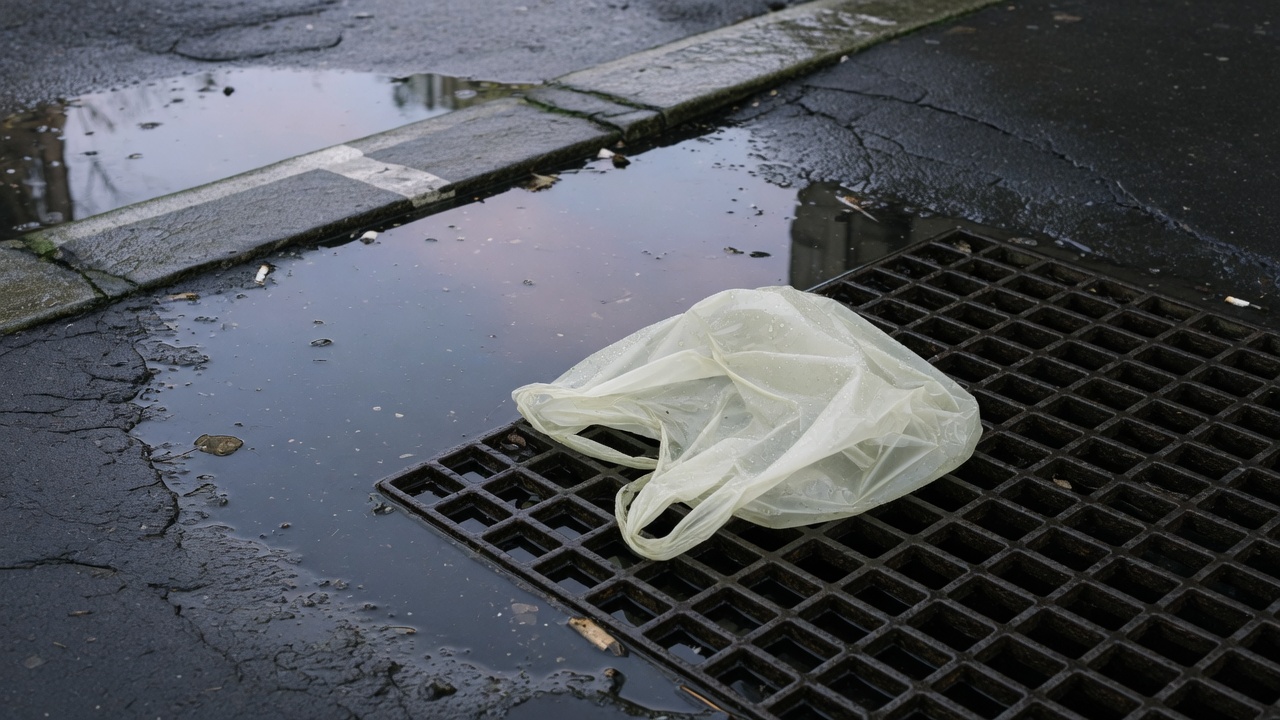
A grate is not a disappearance. It is a doorway. The opening is sized for a tyre’s worth of water, not for a film that balloons, wraps, and threads itself through bars. Once below grade, the bag is in a current with a destination. In a coastal city that destination is often a tidal river. In an inland city it is a river that will, given enough kilometres, meet a sea.
Researchers who sample urban runoff find plastic after storms in concentrations that dry-weather sampling misses. The mechanism is not mysterious. Litter that has been waiting at a curb, in a tree pit, against a fence, is remobilised. Wind does some of the work before the rain. A bag is almost uniquely qualified: high surface area, low mass, a shape that catches air. People litter. People also lose things. Wind does not check intent.
From the drain the object may lodge in a catch basin, where municipal crews, if the city still cleans basins, will eventually pull it out with the sediment. It may travel. Laurent Lebreton and colleagues, modelling riverine plastic emissions in Nature Communications in 2017, estimated that between 1.15 and 2.41 million tonnes of plastic waste reach the oceans from rivers each year, with more than 74 percent of that flux occurring in a handful of wet months, and with a large share concentrated in a relatively small number of catchments. Their calibration was against published river measurements, not against bags specifically. The paper’s force is hydrologic: mismanaged waste plus people plus runoff becomes a pulse. A bag is one of the items that pulse is good at carrying, because it floats until it does not, and it snags until it tears.
Jenna Jambeck’s 2015 Science estimate of land-based plastic reaching the ocean—4.8 to 12.7 million metric tons in 2010 from 192 coastal countries—sits behind that river work as a larger envelope. The two numbers are not required to match. They describe overlapping, not identical, fluxes. Both say the same practical thing: the ocean’s plastic problem is, in large part, a waste-and-water problem on land.
The accidental conveyor
Urban drainage is an achievement. It keeps streets passable and basements dry. The same pipes that make a city habitable in a downpour are, without anyone having voted for it, a conveyor of film. Municipal separate storm-sewer systems—MS4s, in the American regulatory jargon—are permitted as discharges to rivers and bays. Combined systems, older, overflow by design when rain exceeds capacity. In either case the first flush after a dry spell is a sample of whatever the street has been storing: leaves, oil, cigarette filters, bags.
A catch basin can be a trap if it is cleaned. It is a staging area if it is not. Cities that still inventory their inlets know the difference: a bag plastered across a grate is a flood risk as well as a litter item, which is why public-works departments sometimes cared about film before environmental campaigns did. San José’s later monitoring, under a regional trash-reduction permit, found fewer single-use bags in inlets after the checkout ordinance. That is the pathway closing at a measurable point, not a vibe.
Wind is the other conveyor, and it does not wait for rain. A bag left on a cart, on a step, in an unlidded bin becomes airborne at speeds that would not move a bottle. Fences, salt marsh, and mangrove roots are accidental interceptors. So are the branches that make a city look, after a gusty week, as if it had grown polyethylene. Hardesty, Wilcox, and colleagues, surveying Australian coasts with a stratified design, found debris density rising toward urban areas and roads—a domestic geography, not an oceanic one. About three-quarters of what they counted was plastic. The implication for a bag is simple: most of the leakage is local until water takes it farther.
Rivers are not only pipes. They are also filters, in the sense that snags, bars, vegetation, and estuarine fronts hold a large and still poorly quantified share of what enters them. The fraction of bags that reach the open ocean versus remaining in rivers, soils, and infrastructure is not a single global number. Unknown is the right word for that partition. Established is the existence of the route. A policy that only counts what arrives on a famous beach will miss the bags still in the tree and the culvert.
What a bag does when it arrives
On a beach, Ocean Conservancy cleanup volunteers have counted plastic bags among the top items for decades, alongside bottles, wrappers, and caps. Count is not mass, as any net will remind you, but count is how a film appears in civic life: snagged on a reed, wrapped on a turtle, blocking a grate that was supposed to pass a flood.
Chris Wilcox, Nicholas Mallos, George Leonard, Alba Rodriguez, and Britta Denise Hardesty, in their 2016 Marine Policy expert elicitation, asked specialists to rank common shoreline items for entanglement, ingestion, and contamination risk to seabirds, turtles, and marine mammals. Fishing gear led entanglement. Plastic bags ranked with balloons among the worst entanglement hazards after gear, and among the worst ingestion hazards. The ranking is not a laboratory measurement of a particular polymer. It is a structured judgement about shape. A bag is a collapsing volume. It looks, to a turtle that eats jellyfish, like a meal. It looks, to a propeller or a wing, like a trap.
That risk is established as a pathway—animals ingest bags, animals tangle in them—without being a completed account of how many animals, in which populations, die because of grocery film as opposed to agricultural film, balloon latex, or fishing webbing. The honest middle is to take the shape seriously and still refuse to let the grocery bag become the whole ocean.
Once in moving water a bag may sink with biofouling, fragment in sunlight, or continue. Andrady’s work on weathering is as relevant here as it is for bottles and straws: ultraviolet light on a beach makes polymer brittle; the same polymer floating at sea degrades more slowly. The fragments are not a disappearance. They are a change of file size.
Ireland’s pause at the register
In March 2002, Ireland put a levy of 15 euro cents on plastic shopping bags that retailers had been handing out free. The legal instrument was the Waste Management (Environmental Levy) (Plastic Bag) Regulations, under the 2001 Waste Management Act. The point, as Frank Convery, Simon McDonnell, and Susana Ferreira later reconstructed in Environmental and Resource Economics, was litter and landscape, not a precise carbon calculation. The tax was not set at an estimated marginal external cost. It was set high enough to make a person hesitate.
The hesitation worked on the object it targeted. Pre-levy consumption had been estimated at about 1.2 billion bags a year, on the order of 300-plus bags per person. Retailers and the Revenue Commissioners’ receipts implied a drop on the order of 90 percent in the bags subject to the levy, in some supermarket accounts higher. Convery and colleagues called it, with a economist’s irony, among the most popular taxes in Europe. Administration was cheap because it rode on existing value-added-tax reporting. Public acceptance was high. Plastic bags’ share of nationally monitored litter, which Irish authorities had put near 5 percent before the levy, later appeared in official summaries at a fraction of a percent.
That is a studied success on its own terms: fewer thin checkout bags, less of that particular litter, revenue to an environment fund. It is not a parable that travels without luggage.
Usage of the levied bag did not stay at the first-year floor. Per-capita consumption, which fell to the low twenties, drifted back toward the thirties by the mid-2000s, enough that the government raised the levy to 22 cents in 2007. People adapt. They also bought other bags. Critics, including industry groups, pointed to increased sales of kitchen and refuse sacks—the bags you now had to purchase because the free grocery bag was no longer doubling as a bin liner. The magnitude of that substitution is less well measured in Ireland than the drop in checkout bags. The direction is plausible and, in other jurisdictions, documented.
Ireland’s levy also did not, by itself, empty the Irish Sea of plastic. Bags were never most of the mass in the water. Receipts into the environment fund were real money—tens of millions of euros over the first years, more than a hundred million over a longer span in later official tallies—and they were a side effect, not the purpose. The policy’s virtue is narrower and still real: a price at the point of decision can change a habit quickly when the habit was only ever a convenience, and when a reusable substitute is sitting by the door. What it cannot do is substitute for collection, for drain maintenance, or for the heavier debris a levy on grocery film never touches.
Leakage, substitutes, and the mixed record
California’s experience is the necessary counterpart. Cities and then the state restricted thin plastic carryout bags, often with a small fee on paper. Rebecca Taylor, using scanner data and the staggered timing of local ordinances, found in the Journal of Environmental Economics and Management that eliminating thin checkout bags cut a large mass of that film—on the order of 40 million pounds a year in her California estimates—while sales of small and medium trash bags rose sharply, offsetting a substantial fraction of the plastic savings. She also found that a non-trivial share of grocery bags had already been reused as bin liners. Ban the free liner, and some households buy a liner. The leftover policy is not zero. It is smaller than the press release, and heavier, because the replacement bags are thicker.
Paper, meanwhile, is not a ghost. Taylor estimated a large increase in paper-bag mass: paper is heavier per use. If the metric is marine litter of thin film, paper that stays in a bin is an improvement. If the metric is greenhouse gas per trip, the comparison depends on how many times a reusable bag is actually reused, a number that life-cycle studies have worried for years and that shoppers do not always meet.
California later discovered a second leak. The statewide law allowed thicker plastic bags sold as reusable. Many customers treated them as the old bag with a dime attached. Landfill tallies of plastic bags did not fall as advocates had hoped; in some years they rose. The legislature eventually moved to close that loophole. The lesson is not that bans fail. It is that a ban is a specification: of thickness, of fee, of what counts as reusable, of whether the bin liner is in the model.
San José’s 2012 Bring Your Own Bag ordinance is often cited as a cleaner local result. City staff, comparing pre- and post-ordinance litter surveys, reported large drops in single-use plastic bags in storm drains (on the order of 89 percent in the first-year memo), in creeks and rivers (on the order of 60 percent in that memo; later city summaries have put the creek-and-river reduction in the seventies when expressed as share of litter), and on streets. Visual surveys at stores found reusable-bag use rising from a few percent of customers to a majority in early observations. Those figures come from municipal monitoring, not a randomised trial. They are still evidence that a well-enforced checkout rule, in a city that was already counting bags in drains because the state had listed local waters as trash-impaired, can cut the object in the pathway that this article is following.
Fees and bans are not twins. A fee on every bag, including paper, asks a question at every trip. A ban on one polymer, with a free or cheap substitute in another, asks a different question and often gets a different answer. Studies compiled after the first wave of U.S. ordinances found the largest drops in bag use where a charge applied broadly, and more mixed results where a ban without a fee left a replacement on the counter. Reusable bags reduce impact when they are actually reused enough times to amortise their greater mass; they do not do so automatically.
Washington, D.C.’s bag fee, Ireland’s levy, San José’s ban-plus-paper-fee, California’s thickness loophole, Taylor’s trash-bag leakage: the record is mixed in the way engineering records are mixed. The instrument matters. The substitute matters. Whether anyone measures the drain afterwards matters. A policy judged only by the satisfaction of the announcement will always look like a success.
Systems, not sinners
People litter. The sentence is true and insufficient. A city that has too few bins, irregular collection, open trucks, and catch basins that are cleaned on a wish will leak film no matter how many lectures run at the register. A city that prices the bag, keeps the grate, and still has a river will leak less of that bag and still leak bottles, wrappers, and fragments.
The editorial error is to treat the person at the checkout as the whole system because that is the only moment most of us see. The grate is less photogenic. The fishing boat is someone else’s job. The dump on a tributary of a river in another country is easy to file under foreignness, even when the packaging was designed in a headquarters we do know.
Flying River’s method is to follow the object. Store to street is wind, overflow, and habit. Street to drain is gravity and a storm. Drain to stream is a pipe we paid for. Stream to river to coast is the ordinary work of water. Coast to ocean is waves, tides, and time. At each step the bag can stop. Interception is not romantic. It is a boom across a canal, a skimmer in a river, a crew with a grab, a schedule for cleaning basins, a lid on a bin, a deposit on a bottle that makes a bag’s cousin worth bringing back.
The person who carried the groceries is not the system. Neither is the person who drafted the ban. The system is the set of surfaces and pipes that treat a film as if it were rain. Redesign those, and the moral temperature of the checkout matters less than we have been trained to think. Fail to redesign them, and the most virtuous register in the city will still leak on the next windy Tuesday.
Carry a bag that is meant to return with you, if you have the hands and the memory for it. Keep street litter from the curb: the curb is the headwaters. Support designs of drains and booms that intercept material in waterways. Judge bag policy by leakage, not by the pleasure of the prohibition—by whether the film still arrives at the grate, and by whether the substitute is a thicker film that we have merely renamed.
The bag that left the store was never a confession. It was a light object introduced to a landscape that moves water on purpose. Follow the connection far enough and the bag is no longer a bag. It is a lesson about objects that outrun the moment of their use, and about the difference between a current we built and a current we pretended not to see.
Sources
- Jambeck, Jenna R., Roland Geyer, Chris Wilcox, Theodore R. Siegler, Miriam Perryman, Anthony Andrady, Ramani Narayan, and Kara Lavender Law. “Plastic Waste Inputs from Land into the Ocean.” Science 347, no. 6223 (2015): 768–771.
- Lebreton, Laurent C. M., Joost van der Zwet, Jan-Willem Damsteeg, Boyan Slat, Anthony Andrady, and Julia Reisser. “River Plastic Emissions to the World’s Oceans.” Nature Communications 8 (2017): 15611.
- Wilcox, Chris, Nicholas J. Mallos, George H. Leonard, Alba Rodriguez, and Britta Denise Hardesty. “Using Expert Elicitation to Estimate the Impacts of Plastic Pollution on Marine Wildlife.” Marine Policy 65 (2016): 107–114.
- Andrady, Anthony L. “Microplastics in the Marine Environment.” Marine Pollution Bulletin 62, no. 8 (2011): 1596–1605.
- Ocean Conservancy. International Coastal Cleanup cumulative item tallies (plastic bags among top items by count).
- Convery, Frank, Simon McDonnell, and Susana Ferreira. “The Most Popular Tax in Europe? Lessons from the Irish Plastic Bags Levy.” Environmental and Resource Economics 38 (2007): 1–11.
- Waste Management (Environmental Levy) (Plastic Bag) Regulations 2001, Ireland; levy introduced 4 March 2002 at €0.15, later increased.
- Department of the Environment, Community and Local Government (Ireland). Statements on pre-levy consumption (about 1.2 billion bags annually) and on plastic bags’ share of national litter; National Litter Pollution Monitoring System summaries cited in contemporaneous reporting (e.g. Irish Examiner, 1 March 2012).
- Taylor, Rebecca L. C. “Bag Leakage: The Effect of Disposable Carryout Bag Regulations on Unregulated Bags.” Journal of Environmental Economics and Management 95 (2019): 3–23.
- City of San José, Environmental Services Department. “Bring Your Own Bag Ordinance Implementation Results.” Memorandum to the Transportation and Environment Committee, 20 November 2012; and later city summaries of creek, storm-drain, and store-observation results.
- City of San José. Bring Your Own Bag Ordinance (Chapter 9.10, Part 13), effective 1 January 2012.
- Hardesty, Britta Denise, T. J. Lawson, Tonya van der Velde, Matt Lansdell, and Chris Wilcox. “Estimating Quantities and Sources of Marine Debris at a Continental Scale.” Frontiers in Ecology and the Environment 15, no. 1 (2017): 18–25.
The drain is not a disappearance. It is a doorway.
Follow the connection
- Store
- Street
- Storm drain
- Stream
- River
- Coast
- Ocean
What we know
- Thin plastic films are easily moved by wind and water.
- Urban drainage connects streets to streams with very little ceremony.
- Rivers are major conveyors of land-based waste toward coasts.
- Once in moving water, a bag may snag, sink, fragment, or continue.
What remains uncertain
- The fraction of bags that reach the open ocean versus remaining in rivers, soils, and infrastructure is not a single global number.
- How long a given film persists depends on light, chemistry, and mechanical wear.
- Local bag policies have mixed records; leakage depends on substitutes and enforcement as much as on the ban itself.
What can we do?
You don't have to care about this because everyone else does. You can care because the evidence gives you a reason to.
- Carry a bag that is meant to return with you.
- Keep street litter from the curb: the curb is the headwaters.
- Support designs of drains and booms that intercept material in waterways.
- Judge bag policy by leakage, not by the satisfaction of the announcement.
Demonstration authors are fictional. The phenomena discussed are real subjects of public scientific literature and reporting. Sources named in the article are documented; this is not a comprehensive literature review.