Environment
The Forest That Makes Rain
When trees become part of the weather
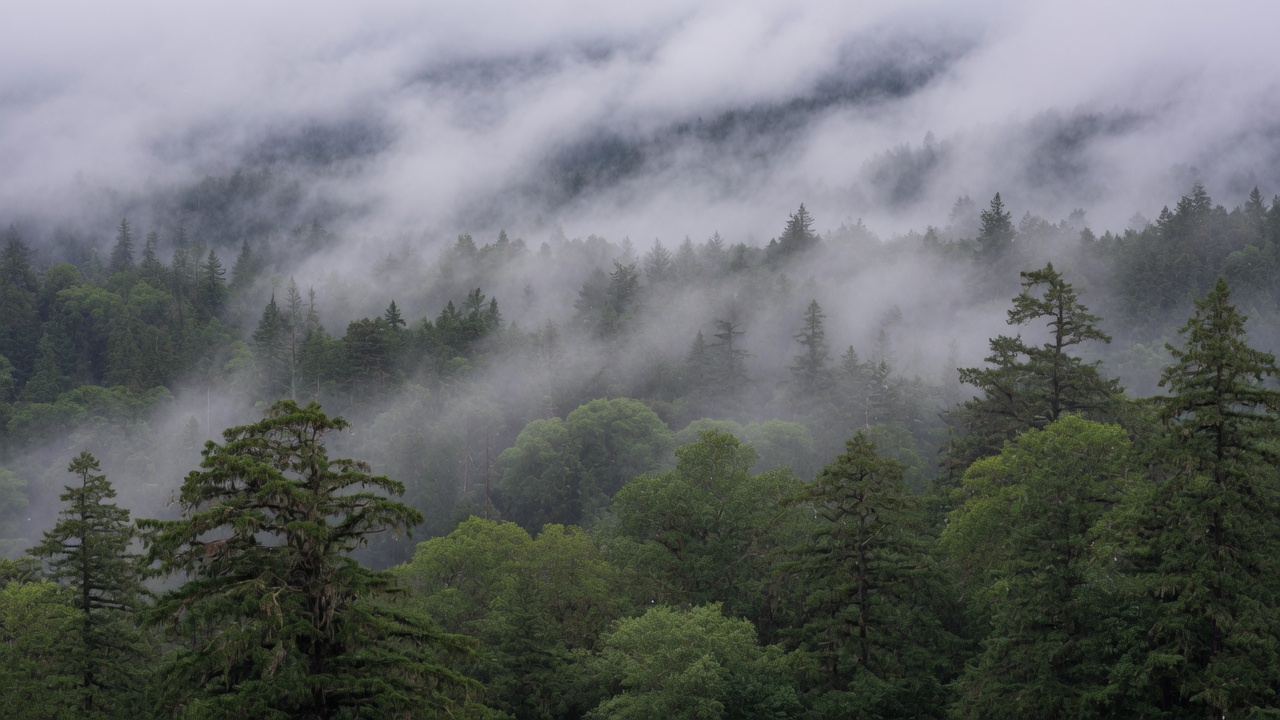
A tree is a slow fountain aimed at the sky.
Roots find water. Leaves open. The air, if it is drier than the interior of the leaf, takes a share. The share is not a leak. It is the price of photosynthesis: stomata open to take in carbon dioxide, and water leaves because the vapor gradient is steep. A single mature tree can lift hundreds of liters in a day. Multiplied by a forest, that flux is large enough to change the humidity of a region, the temperature of a clearing, and—in some well-studied geographies—the rain that falls farther along the wind.
This is not a metaphor borrowed from the flying rivers of South America, though those rivers depend on the same physics. It is evapotranspiration as weather-making: the conversion of soil water into atmospheric moisture, and of solar energy into latent heat, at a scale that meteorology has to treat as a surface condition rather than as landscaping. The physics of the leaf is not controversial. The argument is about how much the leaf matters for the storm two ranges over, and about how easily a slogan—“forests make rain”—hardens into a monsoon switch that no one has actually built.
Flying River will keep the two claims apart. Established: plants move water from soil to air; a large, wet forest returns more moisture and uses more of the sun’s energy that way than a pasture or a dry crop; clearing changes the local climate, usually toward warmer days and, often, toward drier air. Probable: in the interiors of tropical continents, that returned moisture contributes measurably to downwind rainfall. Contested: that condensation over forests is itself a pump that draws ocean air inland. Unknown, in the sense that no honest restoration prospectus can fill it in: how much planting would restore a rainfall regime that clearing helped to thin.
The leaf as a climate surface
The atmosphere over land is not a blank slab waiting for an ocean breeze. It is continuously restocked, or not, by whatever is growing underneath it. When a forest is replaced by pasture or short crops, two things usually happen at once. Less water is returned to the air, because shallow-rooted, seasonally dormant vegetation cannot match a deep, evergreen canopy. And more of the sun’s energy remains as sensible heat—the kind you feel as temperature—because less of it is spent evaporating water.
Deborah Lawrence and Karen Vandecar, reviewing tower, ground, and satellite evidence in Nature Climate Change, put the local result plainly: tropical deforestation produces warmer, drier conditions at the scale of the clearing. That is not a modeler’s prejudice. Flux towers over Amazon pasture have measured higher daytime temperatures and lower evapotranspiration than adjacent forest. The difference is largest in the dry season, when a forest with deep roots is still transpiring and a pasture has already gone quiet. David Ellison, Martyn Futter, and Kevin Bishop, writing in Global Change Biology in 2012, called this the old forest–water-yield debate seen from the other end of the telescope. At the scale of a small catchment, trees are water users: cut them and the stream often rises. At the scale of a region, the same trees are water suppliers: they load the air that will rain somewhere else. Both statements can be true. The error is to treat the catchment as the whole hydrology.
Ellison and a large group of coauthors returned to the point in 2017, in Global Environmental Change, arguing that forest–water–energy cycles are still treated as a footnote to carbon. A tree that transpires a hundred liters has also performed a cooling. The energy that went into vaporization did not go into heating the canopy. That is as physical as a swamp cooler. It does not require a theory of planetary salvation. It requires noticing that a forest is an evaporating surface with a height, a roughness, and a rooting depth, and that those properties are climate variables.
Oceans still dominate many moisture budgets. Rudi van der Ent and colleagues, tracking atmospheric moisture in ERA-Interim reanalysis, estimated that on average about forty percent of terrestrial precipitation originates from land evaporation, and that about fifty-seven percent of terrestrial evaporation falls again as rain over land. The rest of the rain on land is an ocean import. That is the honest fraction. A forest is a modifier of a system whose first reservoir is still the sea. Continental interiors feel the modifier more than coasts do. Van der Ent’s maps are not a license to say that trees invented the monsoon. They are a map of dependence: the Río de la Plata basin drawing a large share of its water from Amazon evaporation; China’s rainfall drawing heavily on Eurasian land evaporation; the Congo drawing on moisture that evaporated over East Africa, particularly the Great Lakes region. The numbers will move as the reanalyses improve. The geography of the dependence is the finding.
Air that has passed over forest
Dominick Spracklen, Stephen Arnold, and Christopher Taylor asked a question that a flux tower cannot answer alone. They used satellite rainfall and vegetation, and they tracked air backward for a few days. For more than sixty percent of the tropical land surface between 30°S and 30°N, air that had recently passed over extensive vegetation produced at least twice as much rain as air that had passed over little vegetation. The correlation was consistent with evapotranspiration keeping the air moist. Combining the empirical relationship with then-current Amazonian deforestation trends, they estimated reductions on the order of twelve percent in wet-season precipitation and twenty-one percent in dry-season precipitation across the basin by 2050, from less efficient moisture recycling.
That 2012 Nature paper is not a photograph of a future drought. It is an observational argument with a projection attached. The observational core has been the more durable part: air that has travelled over forest arrives wetter and rains more than air that has travelled over a thinned landscape. How far the effect reaches, and how cleanly it can be separated from the fact that forests grow where rain already falls, is the usual circularity in this field. Spracklen’s method tries to break the circle by following the air, not the biome boundary.
Delphine Zemp and colleagues followed observation-based water fluxes from source to sink. In Geophysical Research Letters in 2017 they reported that deforestation scenarios can reduce dry-season rainfall by up to about twenty percent well away from the cut—over the western Amazon and the La Plata basin—and that the remaining forest’s resilience is thereby eroded, especially in the southwest. In Nature Communications the same year they treated Amazon patches as a network linked by atmospheric moisture. Self-amplified forest loss, in their framework, rises nonlinearly as the dry season intensifies. Under rainfall reductions comparable to Last Glacial Maximum conditions, additional forest loss from the feedback occurred in about ten to thirteen percent of the basin. They did not find a complete dieback under then-projected twenty-first-century rainfall changes. They did find that extreme droughts have the potential to destabilize large parts of the forest if the moisture recycling that the forest itself supplies is weakened.
A feedback is not a prophecy. It is a reason the error bars on “how much forest can we lose before the rain changes” are not a comfort. Lovejoy and Carlos Nobre’s later warning about an Amazon tipping zone belongs to that family of arguments. Flying River will not pretend that a percentage of clearing is a known tripwire. We will say that moisture recycling is a feedback, that feedbacks can be nonlinear, and that the local climate after a cut is already a measured object, not a speculation.
After the cut: warmer, sometimes drier
The local climate of a new clearing is the part of this story that needs the least faith. Remove the canopy and the ground takes more sun. Remove the transpiration and the air above the ground is drier in the daytime. Nights can be a different story: a forest canopy can trap heat; a bare field can radiate it. The public phrase “deforestation warms” is, at the local scale, mostly a daytime and dry-season statement, and it is well supported.
Lawrence and Vandecar’s synthesis is useful here because it refuses a single scale. In general circulation models, complete tropical deforestation produces substantial warming and drying in the tropics—warming that, in the most extreme experiments, has been compared in magnitude to a large share of historical fossil-fuel warming, with the important caveat that complete tropical deforestation is not a policy scenario. More realistic partial-clearing experiments produce less warming and less drying. In regional models that resolve topography and the sharp edge between forest and field, small clearings can increase local rain, by setting up breezes at the forest edge. Grow the clearing past a threshold—Lawrence and Vandecar pointed to studies in which the sign flipped on the order of tens of thousands of square kilometres—and rainfall declines. Civic debate prefers one arrow. The atmosphere keeps a size dependence.
That size dependence is why a satellite image of a fishbone of logging roads is not yet a climate diagnosis, and why a continent of pasture is not a collection of fishbones. Paulo Artaxo and others have made the same point from the aerosol and cloud side: the mechanism changes with the size of the cut. A small opening can loft more cloud. A large opening can dry the column.
None of this requires us to say that every farm is a climate crime. It requires us to stop treating the microclimate of a cleared hectare as if it were only the farmer’s business. Heat extremes over tropical farmland are not an abstraction in a review article. They are the working day.
A pump that is still on trial
There is a further claim, and it should be labelled as what it is.
Anastassia Makarieva and Victor Gorshkov proposed, in Hydrology and Earth System Sciences in 2007, that condensation over a wet forest does more than moisten the air. By converting water vapor to liquid, it reduces the volume of the gas, drops the pressure, and helps draw moist air in from the ocean—a “biotic pump.” If the mechanism were as strong as they argue, a coastal forest would not only recycle rain. It would help to cause the onshore wind that delivers the ocean’s moisture in the first place. Inland forests would keep the conveyor running. Cut the forest back to the coast and the interior, on this account, would not merely lose recycled rain. It would lose the import.
The idea is physically argued. It is not universally accepted. A. G. C. A. Meesters, A. J. Dolman, and L. A. Bruijnzeel published a comment in the same journal arguing that the “evaporative force” on which the theory rests is not supported as a first-order driver, and that the effect on moisture transport is negligible compared with the ordinary temperature and pressure gradients that meteorologists already put in their models. Isaac Held, reviewing a later paper, described the condensation effect as small and already present in some models. Gavin Schmidt has called the broader claim nonsense. Makarieva and colleagues have answered, at length, that critics misplace the heating and the pressure drop in the column.
Flying River will not promote a disputed mechanism into a certainty, and will not pretend that a standoff is a secret. What does not require the biotic pump is already enough: evapotranspiration happens; recycling happens; the surface energy budget changes when a forest becomes a field; Spracklen’s air masses rain more after forest than after sparse vegetation; Zemp’s fluxes show downwind drying in deforestation scenarios. Those statements survive if the pump is weak. They also survive if the pump is later shown to be stronger than the mainstream allows. The editorial duty is not to pick a winner in a theoretical fight. It is to refuse to launder the fight into a children’s book about trees that inhale the Atlantic.
Restoration is not a monsoon switch
If a forest is part of the weather, then planting one looks like climate engineering with shovels. The temptation is obvious, and it should be resisted in that form.
Catchment studies going back decades show that afforestation often reduces local streamflow, because the new trees transpire. Robert Jackson and colleagues, in Science in 2005, warned that trading water for carbon with biological sequestration can dry streams and salinize soils in the wrong places. A dryland plantation is not a tropical moist forest. It does not automatically restart a recycling loop that a different forest, in a different wind field, once maintained. Ellison’s scale argument cuts both ways. The regional moisture benefit, if it exists, is not a property of a seedling. It is a property of a large, wet, persistent canopy in a geography that already has an ocean upwind and a continent downwind.
Even in the Amazon, putting trees back is not a guaranteed reversal of a rainfall decline. The remaining forest’s resilience, in Zemp’s account, is already being asked to do more work. Fire, fragmentation, and a lengthening dry season are not undone by a restoration map. A planted stand may take decades to root as deeply as what was cut. The air does not wait. And the ocean, El Niño, and greenhouse warming will still move rainfall while the seedlings grow. Attribution of a particular wet season to a particular restoration project will be difficult for the same reason attribution of a particular drought to a particular cut is difficult. Direction is clearer than a year’s accounting.
That is not an argument against restoration. It is an argument against selling restoration as a monsoon switch. Protecting an existing moist forest that already transpires through the dry season is a different, more immediate hydrological act than planting a new one and waiting. The first keeps a pump that is running. The second is an experiment with a long lag and a geography that has to be right.
Knowledge that was never only a model
Indigenous and local knowledge of hydroclimates is not a decorative epigraph for a science story. It is a record of people who have had to notice, in order to eat and travel, when rain arrives, from which direction, after which kind of year, and after which kind of clearing.
In Amazonia, the remaining large blocks of forest include Indigenous territories that have been far more effective at keeping canopy than the surrounding frontier. Moisture-tracking studies that credit Amazon evaporation with a large share of rain in the Center-West and the La Plata basin are, among other things, a description of work those forests still do. The people who live in them have not needed a reanalysis product to know that a neighboring fazenda gone to pasture is not only a change in the view. Streams fail. Dry seasons lengthen. Smoke and heat sit differently. That observation is empirical hydrology. It does not become less empirical because it was not first published in Nature.
The same is true, in a different wind field, of East African highlands and lakes whose evaporation, in van der Ent’s accounting, feeds Congo rainfall, and of Congo forest whose moisture in turn matters to the Sahel. Pastoral and farming calendars in those corridors are readings of a hydroclimate, not folklore pasted onto a map. A model that omits land-cover change will keep being surprised by a drought that a herder already had a word for.
The useful stance is not to treat Indigenous knowledge as a spiritual upgrade to a satellite, or as a substitute for a moisture-tracking model. It is to let both speak, and to notice when a government treats a forest as timber and carbon only, omitting the third account: weather. The people who have been defending the canopy were defending a climate surface whether or not the ministry had a name for one.
What the fountain is for
Follow the connection far enough and a tree is no longer a carbon offset with leaves. It is a slow fountain aimed at the sky, and the sky is a commons that does not end at the fenceline.
You don’t have to care about this because a campaign told you that planting a tree commands the rain. You can care because the leaf’s work is real, the local climate after clearing is measured, the downwind moisture is a probable contribution with honest error bars, and the pump that would make forests the engine of the wind is still a research dispute. Those four sentences can occupy the same page. They should.
The ocean will still be the first reservoir. A restored woodlot will not restart a monsoon. A pasture will still be warmer at midday than the forest it replaced. None of that is a fairy tale, and none of it is landscaping. It is weather, made in part by living things, on a schedule that can be interrupted.
Sources
- Spracklen, D. V., S. R. Arnold, and C. M. Taylor. “Observations of Increased Tropical Rainfall Preceded by Air Passage over Forests.” Nature 489 (2012): 282–285.
- Zemp, Delphine Clara, et al. “Self-Amplified Amazon Forest Loss Due to Vegetation-Atmosphere Feedbacks.” Nature Communications 8 (2017): 14681.
- Zemp, D. C., et al. “Deforestation Effects on Amazon Forest Resilience.” Geophysical Research Letters 44, no. 12 (2017): 6182–6190.
- Ellison, David, Martyn N. Futter, and Kevin Bishop. “On the Forest Cover–Water Yield Debate: From Demand- to Supply-Side Thinking.” Global Change Biology 18, no. 3 (2012): 806–820.
- Ellison, David, et al. “Trees, Forests and Water: Cool Insights for a Hot World.” Global Environmental Change 43 (2017): 51–61.
- van der Ent, Rudi J., Hubert H. G. Savenije, Bettina Schaefli, and Susan C. Steele-Dunne. “Origin and Fate of Atmospheric Moisture over Continents.” Water Resources Research 46, no. 9 (2010): W09525.
- Lawrence, Deborah, and Karen Vandecar. “Effects of Tropical Deforestation on Climate and Agriculture.” Nature Climate Change 5 (2015): 27–36.
- Makarieva, A. M., and V. G. Gorshkov. “Biotic Pump of Atmospheric Moisture as Driver of the Hydrological Cycle on Land.” Hydrology and Earth System Sciences 11 (2007): 1013–1033.
- Meesters, A. G. C. A., A. J. Dolman, and L. A. Bruijnzeel. Comment on “Biotic Pump of Atmospheric Moisture as Driver of the Hydrological Cycle on Land” by A. M. Makarieva and V. G. Gorshkov. Hydrology and Earth System Sciences 13 (2009): 1299–1305.
- Makarieva, A. M., V. G. Gorshkov, D. Sheil, A. D. Nobre, and B.-L. Li. “Where Do Winds Come From? A New Theory on How Water Vapor Condensation Influences Atmospheric Pressure and Dynamics.” Atmospheric Chemistry and Physics 13 (2013): 1039–1056.
- Jackson, Robert B., et al. “Trading Water for Carbon with Biological Carbon Sequestration.” Science 310, no. 5756 (2005): 1944–1947.
- Lovejoy, Thomas E., and Carlos Nobre. “Amazon Tipping Point.” Science Advances 4, no. 2 (2018): eaat2340.
A tree is a slow fountain aimed at the sky.
Follow the connection
- Sunlight
- Trees
- Evapotranspiration
- Atmospheric moisture
- Rain
- Forest
What we know
- Plants move water from soil to air through transpiration.
- Large forests can return enough moisture to influence humidity and, in some regions, downwind rainfall.
- Deforestation changes surface energy and moisture; local climate often changes with it.
What remains uncertain
- The strength of “forests make rain” varies by continent, wind pattern, and season.
- How much restoration would restore a rainfall regime is not a solved equation.
- Ocean moisture still dominates many systems; forests are a modifier, not a magic origin.
What can we do?
You don't have to care about this because everyone else does. You can care because the evidence gives you a reason to.
- Treat forest protection as weather infrastructure where the evidence supports a moisture role.
- Be wary of both denial (“trees are just scenery”) and overclaim (“plant a tree, command the monsoon”).
- Support research and indigenous and local knowledge of regional hydroclimates.
Demonstration authors are fictional. The phenomena discussed are real subjects of public scientific literature and reporting. Sources named in the article are documented; this is not a comprehensive literature review.