Environment
The River You Cannot See
How atmospheric rivers move invisible oceans through the sky
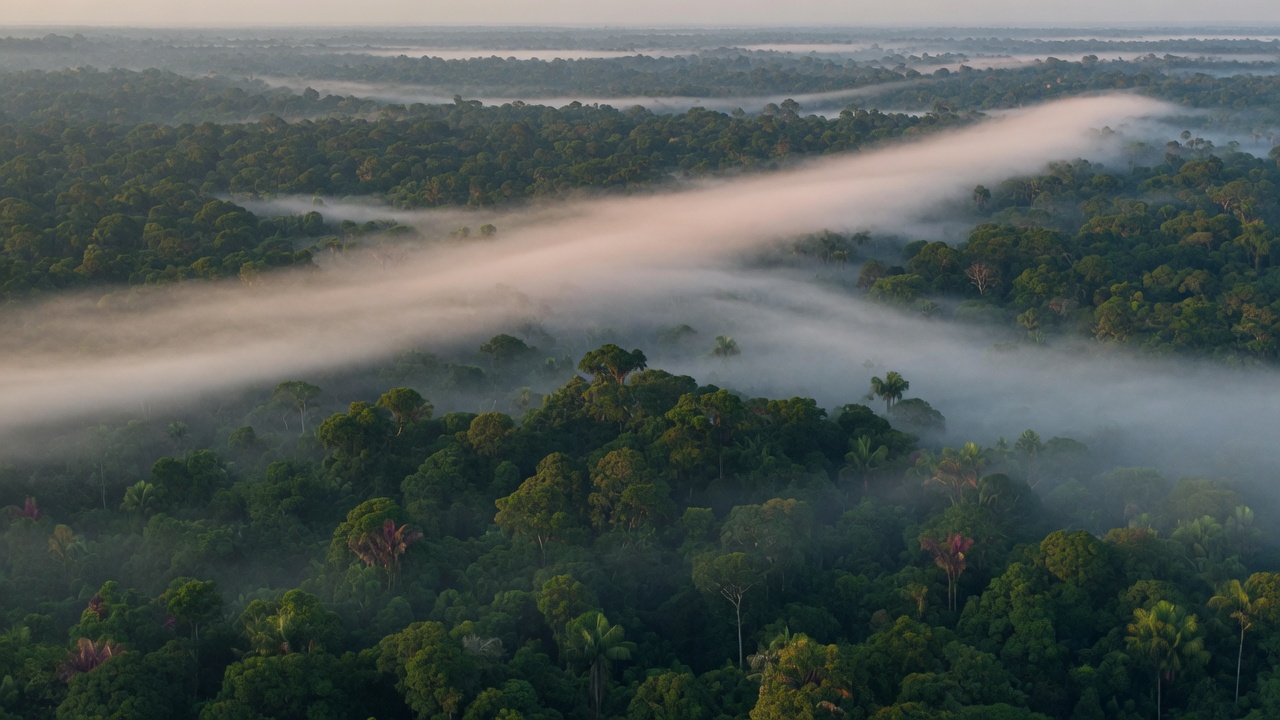
The atmosphere does not look like a river. There is no shoreline, no current visible from a bridge, no place where you could put your feet in the water. And yet, above the forest, water is moving.
In South America, researchers and writers have long used the phrase rios voadores—flying rivers—to describe vast flows of water vapor carried by winds from the Atlantic, lifted and replenished by the Amazon, and delivered as rain to lands that would otherwise be much drier. The metaphor is not poetry laid on top of science. It is a way of making a physical fact legible: enormous quantities of water travel without ever appearing as a conventional river.
That fact is older than the phrase. What has changed is our ability to follow the water after it leaves the leaf, and our reasons for wanting to. Droughts in agricultural interiors, arguments over deforestation, and a more precise vocabulary for storms that drench extra-tropical coasts have all made the same demand: treat moisture in the air as infrastructure, not as scenery.
An ocean with no banks
Sunlight lifts water from the tropical Atlantic. Trade winds carry that moisture west. When the air meets forest, the story does not end in a simple rain-and-runoff cartoon. Trees pull water from soil and release it through their leaves. That returned moisture can travel farther inland, falling, evaporating, and rising again. A forest is not only a user of rain. In the right geography, it is part of the machinery that makes rain possible farther on.
The Brazilian climatologist Eneas Salati showed, in work that began in the 1970s, that the Amazon recycles a large share of its own rainfall. Using the changing ratio of oxygen isotopes in rainwater from the Atlantic coast toward the Andes, he and his colleagues demonstrated that air masses crossing the basin are repeatedly moistened by the forest. Later estimates have put that recycling in the neighborhood of half the basin’s rainfall, with the dependence growing as one moves west, farther from the ocean’s first gift. The numbers are not a single sacred percentage. They are a direction: inland rain is not only an import from the sea.
Antonio Nobre, of Brazil’s National Institute for Space Research, has put a more public figure on the daily work of the trees. He has calculated that Amazonian vegetation returns on the order of twenty billion tonnes of water to the air each day—comparable, in his comparison, to the Amazon River’s discharge into the Atlantic, which at roughly two hundred thousand cubic metres per second is about seventeen billion tonnes a day. Those are order-of-magnitude illustrations, not a hydrologic identity. A river you can photograph and a vapor flux you cannot are not the same object. They are, however, the same kind of accounting: a continent-scale movement of water.
José Marengo popularized rios voadores in Brazil for a related, more meteorological object: low-level jets that carry moisture across Amazonia and, blocked and turned by the Andes, south toward the Center-West, Southeast, and South of Brazil and on into Paraguay, Uruguay, and northern Argentina. The pilot Gérard Moss later flew sampling campaigns along those trajectories. The public phrase did what a journal article often cannot. It gave a civic object to a flux.
Meteorologists also speak of atmospheric rivers in a more technical sense, and the two ideas should not be mashed into one. In the usage that followed Yong Zhu and Reginald Newell’s late-1990s papers, an atmospheric river is a long, narrow corridor of concentrated water vapor, typically associated with the warm sector of an extratropical cyclone. Such corridors occupy a small fraction of a latitude circle—on the order of a tenth—yet they carry most of the poleward moisture transport in the midlatitudes. When they make landfall against mountains, they can deliver a large share of a region’s annual rain and snow in a handful of events. California’s winter water, and California’s winter floods, are often the same storms. F. Martin Ralph, Michael Dettinger, and colleagues have shown that atmospheric rivers account for a substantial portion—commonly cited in the range of thirty to fifty percent, and in some Sierra and coastal analyses higher—of California’s precipitation, and for a still larger share of its most damaging runoff.
You can see the clouds. You cannot see the river. The invisibility is not a metaphor for ignorance. It is a property of water in the gas phase, moving in a current that has width, direction, and a hydrograph, and that refuses to appear on a highway map.
Why invisibility matters
A river on a map invites a kind of civic attention. People argue about dams, rights, pollution, and restoration because the object is obvious. An aerial river is easier to ignore until a rainy season fails, or until a city discovers that its water did not originate in the reservoir that holds it.
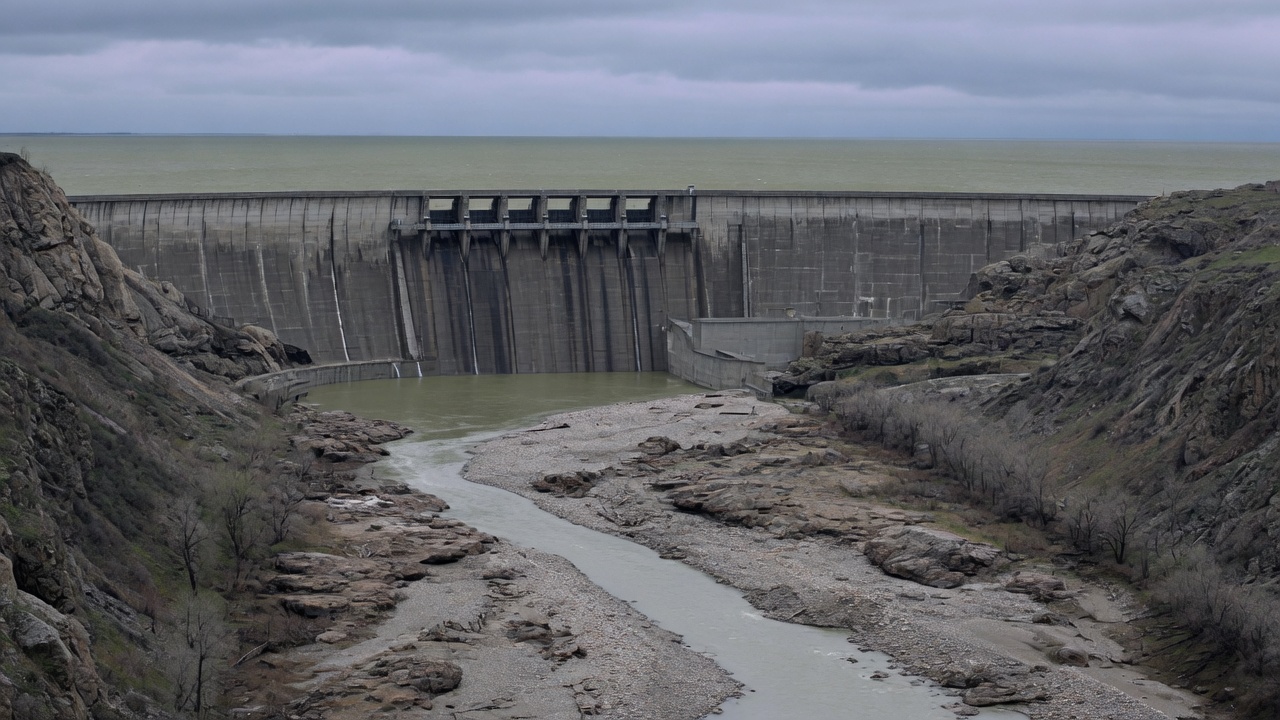
São Paulo’s 2014–2015 water crisis, and the droughts that have since returned to parts of central and southeastern Brazil, were not caused by a single missing flying river in the way a broken pipe causes a dry tap. Weather is not a faucet. But the public argument that followed—about reservoirs, about consumption, about the forest several states away—was an argument about a supply chain that had never been drawn as a supply chain. Coffee, soy, hydropower, and the taps of cities that produce a large share of Brazil’s economic output sit downwind of moisture that has passed over the Amazon. Nobre has argued, in language meant to be heard outside a laboratory, that without that moisture much of southern Brazil would be far more arid. The precise counterfactual is a model, not a photograph. The dependence is not a slogan.
The same civic blindness appears, in a different climate, along the North American West Coast. Atmospheric rivers are now a category in operational forecasting. They have intensity scales. They are named in headlines. That is progress, and it is recent. For most of the twentieth century the same storms were simply “the pineapple express” or a wet week. Once they are a class of object, one can ask better questions: How much of this year’s snowpack arrived in three plumes? What happens to a reservoir if the next winter’s rivers in the sky stall offshore? Who lives in the alluvial fan that will take the flood when a strong landfall stalls against a range?
This is the editorial premise of Flying River, and it begins here. Some of the most important forces in our world are difficult to see. They move quietly through systems, accumulate over time, connect distant places, and produce consequences far from their source.
None of that requires us to pretend we can specify, to the liter, how a particular tract of forest changed a particular season of rain. The direction of the connection is clearer than the precise accounting. That is a normal condition in Earth science. It is not an excuse to stop looking.
The forest as a pump
A mature tree can lift hundreds of liters of water into the air in a single day. The site’s own standing fact is a version of that observation, and it is not a curiosity for a children’s book. Multiplied by a forest, transpiration is a flux large enough to alter the humidity of a region.
The physics is not exotic. Water in the leaf is at a higher potential than water in dry air. Stomata open to take in carbon dioxide; water leaves. In a tropical forest the canopy is a stacked evaporating surface. Nobre has described Amazon evaporation on the order of several millimetres a day—several liters per square metre—which, over millions of square kilometres, becomes the daily billions of tonnes. Pasture and cropland, especially in the dry season, do not transpire at the same rate. The forest’s advantage is not only that it is green. It is that deep roots and a persistent canopy keep moving water when a cleared field has already gone quiet.
That difference matters for the downwind neighbor. Dominick Spracklen and colleagues, tracking air backward over tropical land, found that air which has recently passed over extensive vegetation produces substantially more rain than air that has passed over little vegetation. Delphine Zemp and colleagues, following observation-based moisture fluxes, have argued that deforestation can reduce dry-season rainfall far from the cleared patch—over the western Amazon and the La Plata basin—by amounts on the order of tens of percent in some scenarios, and that the remaining forest’s resilience is thereby eroded. A 2017 paper in Geophysical Research Letters put a dry-season reduction of up to about twenty percent well downwind of the cut. Later work has continued to worry the same bone: historical clearing in the southern Amazon is implicated in a measured drying, not only in a modeled one.
There is a further, more contested claim. Anastassia Makarieva and Victor Gorshkov have proposed that condensation over forests can itself help draw moist air inland—a “biotic pump.” The idea is physically argued and not universally accepted. Many meteorologists hold that large-scale circulation is set by the temperature contrast between land and ocean, by the Andes, and by the seasonal march of the sun, with forests as important modifiers rather than as engines. Flying River will not promote a disputed mechanism into a certainty. We will say what does not require it: evapotranspiration happens; recycling happens; clearing changes the surface energy budget and the moisture available to the air that leaves. Those statements are established. How hard a given hectare of forest “pulls” on the Atlantic is a research question.
Carlos Nobre, Thomas Lovejoy, and others have warned of a related threshold: enough deforestation, fire, and drying, acting together, could push large parts of eastern, southern, and central Amazonia toward a more open, less forested state. Lovejoy and Nobre suggested, in Science Advances in 2018, that the danger zone might begin near twenty to twenty-five percent clearing, lower than earlier model estimates around forty percent. Tipping-point language is easy to overuse. It is also easy to dismiss as drama. The honest middle is that moisture recycling is a feedback, feedbacks can be nonlinear, and we will not know the exact percentage by crossing it on purpose.
Two rivers, one lesson
It is tempting, on a site named for flying rivers, to treat the Amazonian vapor flux and the midlatitude atmospheric river as twins. They are cousins.
Both are concentrated moisture transport. Both couple a distant ocean to an inland or orographic rain. Both are easy to miss until they fail or overperform. They differ in mechanism and in what a person can do about them.
An atmospheric river, in the Zhu–Newell sense, is a filament in a cyclone’s warm conveyor. You cannot plant one. You can forecast it, design reservoirs and floodways for a world in which a few events dominate the year, and stop being surprised that “average rainfall” arrives as a handful of plumes. The U.S. West Coast, western Europe, and parts of Chile live with that statistics. Guan and Waliser have shown that landfalling atmospheric rivers are associated with a large fraction of extreme precipitation and wind along many midlatitude coasts.
A flying river in the South American sense is a climatology as much as a storm: trade winds, forest recycling, an orographic wall, a southward jet. You cannot forecast a forest the way you forecast a landfall, but you can keep or lose the transpiring surface that helps load the jet. The intervention, if there is one, is land use hundreds of kilometres upwind of the farm.
What the two share, editorially, is the error of localism. Drought is reported as a local failure of rain. Flood is reported as a local excess. Both are often the arrival or non-arrival of water that has already had a career.
What the measurements cannot yet do
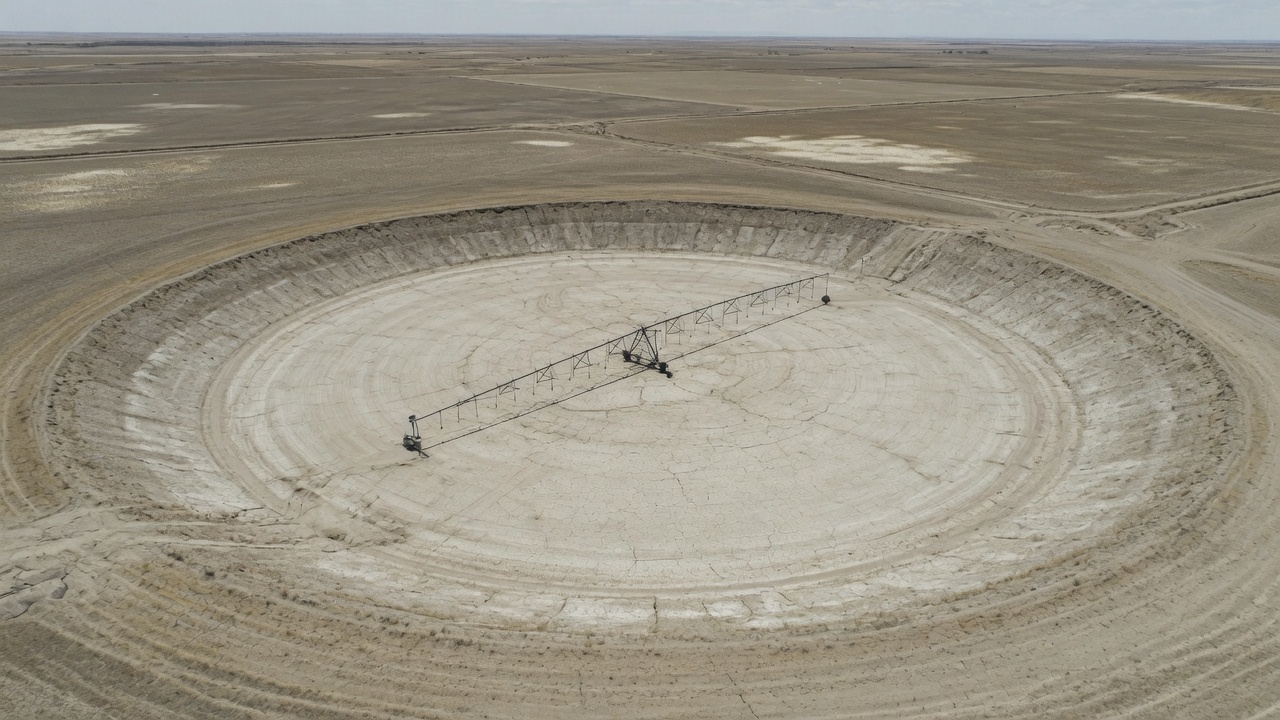
Follow the connection far enough and you meet the usual Earth-science wall. Models and field measurements do not always agree on magnitude, even when they agree on direction. Attribution of a particular drought or flood to a particular forest change remains difficult. Ocean variability, El Niño and its opposite, aerosol, and greenhouse warming all move rainfall. Isolating the forest’s share in a given year is a research problem, not a press release.
There is also a scale problem. A small clearing can, in some tropical studies, increase local cloudiness by creating breezes at the forest edge. A large clearing can dry the region. Paulo Artaxo and others have noted that the size of the cut changes the mechanism. Civic debate prefers a single arrow. The atmosphere does not.
Indigenous and local knowledge of regional hydroclimates is not a substitute for a moisture-tracking model, and a model is not a substitute for people who have watched a stream fail after a neighboring fazenda went to pasture. The useful stance is to let both speak, and to notice when a government treats the forest as timber and carbon only, omitting the third account: weather.
The biography of rain
If you live far from a rainforest, this can feel like someone else’s hydrology. It is not. Agricultural interiors, hydroelectric reservoirs, and city taps are downstream of moisture trajectories whether or not those trajectories appear on a postcard. The same is true, in different geographies, of atmospheric rivers that rake extra-tropical coasts. A ski town in the Sierra, a vineyard in Mendoza, a reservoir serving a Brazilian metroplex, a floodplain in Washington State: all of them live with water that was recently somewhere else, in a form no one photographed as a river.
The useful question is not “Do I personally control the Amazon?” It is: what is happening here that most people can’t easily see—and what happens if we follow the connection far enough?
Far enough, in this case, is simply this: water has a route, even when the route is air. A route can be interrupted. It can also be kept. Conservation of forests that are known moisture sources is not an aesthetic preference and not only a carbon policy. It is maintenance of a conveyor. So is reading the next drought story as a systems story—asking which ocean, which wind, which upwind land surface failed to deliver—rather than as a local moral.
You don’t have to care about this because a campaign told you to. You can care because rainfall has a biography, and biographies can be interrupted. The atmosphere will still not look like a river. That was never the requirement. The requirement was to stop confusing the absence of a bank with the absence of a current.
Sources
- Salati, Eneas, and Peter B. Vose. “Amazon Basin: A System in Equilibrium.” Science 225, no. 4658 (1984): 129–138.
- Zhu, Yong, and Reginald E. Newell. “A Proposed Algorithm for Moisture Fluxes from Atmospheric Rivers.” Monthly Weather Review 126, no. 3 (1998): 725–735.
- Dettinger, Michael D., F. Martin Ralph, Tapash Das, Paul J. Neiman, and Daniel R. Cayan. “Atmospheric Rivers, Floods and the Water Resources of California.” Water 3, no. 2 (2011): 445–478.
- Guan, Bin, and Duane E. Waliser. “Detection of Atmospheric Rivers: Evaluation and Application of an Algorithm for Global Studies.” Journal of Geophysical Research: Atmospheres 120, no. 24 (2015): 12514–12535.
- Ralph, F. Martin, et al. Work on landfalling Pacific atmospheric rivers and West Coast precipitation, including Ralph et al., “Flooding on California’s Russian River: Role of Atmospheric Rivers,” Geophysical Research Letters 33 (2006).
- Spracklen, D. V., S. R. Arnold, and C. M. Taylor. “Observations of Increased Tropical Rainfall Preceded by Air Passage over Forests.” Nature 489 (2012): 282–285.
- Zemp, Delphine Clara, et al. “Self-Amplified Amazon Forest Loss Due to Vegetation-Atmosphere Feedbacks.” Nature Communications 8 (2017): 14681.
- Zemp, D. C., et al. “Deforestation Effects on Amazon Forest Resilience.” Geophysical Research Letters 44, no. 12 (2017): 6182–6190.
- Lovejoy, Thomas E., and Carlos Nobre. “Amazon Tipping Point.” Science Advances 4, no. 2 (2018): eaat2340.
- Nobre, Antonio Donato. The Future Climate of Amazonia: Scientific Assessment Report. São José dos Campos: ARA / CCST-INPE / INPA, 2014.
- Marengo, José A., et al. Papers on South American low-level jets and moisture transport; the phrase rios voadores as popularized in Brazilian public science.
- Projeto Rios Voadores. “The Flying Rivers Phenomenon.” https://riosvoadores.com.br/english/the-flying-rivers-phenomenon/.
- BBC Brasil. “O que são os ‘rios voadores’ que distribuem a água da Amazônia.” 2017.
- Pearce, Fred. “Rivers in the Sky: How Deforestation Is Affecting Global Water Cycles.” Yale Environment 360, 24 July 2018.
The atmosphere does not look like a river. There is no shoreline, no current visible from a bridge, no place where you could put your feet in the water. And yet, above the forest, water is moving.
Follow the connection
- Ocean evaporation
- Trade winds
- Forest transpiration
- Aerial moisture
- Rain inland
What we know
- Water evaporates from oceans and is carried by wind.
- Forests return large amounts of water to the air through transpiration.
- Atmospheric rivers—long corridors of concentrated moisture—are an established feature of weather systems.
- The South American idea of rios voadores names a related fact: moisture from the Atlantic and the Amazon can travel inland and fall as rain far from its source.
What remains uncertain
- How much any single landscape change alters rainfall hundreds of kilometers away is still an active research problem.
- Models and field measurements do not always agree on magnitude, even when they agree on direction.
- Attribution of a particular drought or flood to a particular forest change remains difficult.
What can we do?
You don't have to care about this because everyone else does. You can care because the evidence gives you a reason to.
- You don’t have to care about this because everyone else does. You can care because rainfall has a biography, and biographies can be interrupted.
- Support conservation of forests that are known moisture sources for inland regions.
- Read drought and flood coverage as systems stories, not only local weather.
- Ask, when land is cleared, where the water that used to leave those leaves will go instead.
Demonstration authors are fictional. The phenomena discussed are real subjects of public scientific literature and reporting. Sources named in the article are documented; this is not a comprehensive literature review.