Wildlife
The Shell That Became Too Thin
What DDT taught us about consequences that arrive years after the cause
The bird did not know what DDT was. It only knew that something had changed.
For a time, the change was easy to miss. Adult birds still flew. Fields were quieter, which many people counted as success. The failure appeared in a place few casual observers inspect: the shell. Eggs broke under the weight of incubation. Clutches failed. Populations of peregrine falcons, bald eagles, and other raptors declined in regions of heavy use.
A delay is not an absence. The spray was a public act; the thinning was a private one, occurring in a gland, over hours, inside a body that still looked intact. The editorial lesson is not that every industrial chemical is DDT. The lesson is that a system can look intact while a load-bearing part of it is thinning.
A useful poison
Dichlorodiphenyltrichloroethane was first synthesized in 1874. Its insecticidal power was not. In 1939, Paul Hermann Müller, working for the Swiss firm Geigy, found that the compound killed insects at doses that, in the first years of use, seemed sparing of mammals. During the Second World War it was applied against lice and mosquitoes. Müller received the Nobel Prize in Physiology or Medicine in 1948. After the war, agriculture and public-health campaigns put it into the ordinary air of farms, suburbs, and wetlands.
It was valued because it worked. It killed insects that carried disease and insects that ate crops. What was less obvious—because it was slower, and because it happened inside bodies and food webs rather than in the spray tank—was that the compound and its breakdown products did not simply vanish. They moved. They accumulated in fat. They became more concentrated in animals that ate other animals.
Established: DDT and its principal persistent metabolite, DDE, are lipophilic and environmentally stubborn. They travel in air, water, and migrating animals. They biomagnify. Those properties were not invented by later controversy. They are why a chemical applied to a field could later appear in the egg of a bird that never stood in that field.
The science that connected that movement to calcium metabolism and eggshell thickness was not instant, and it was not uncontested at the time. It did not need to be instant to become, later, one of the clearest public examples of an indirect ecological effect.
What the museums already knew
Derek Ratcliffe, working for the Nature Conservancy in Britain, did not begin with a chemical. He began with a field fact that did not match the books. Peregrine falcons were breaking eggs. In 1958 he published the observation that breakage in eyries had become frequent in a way that older naturalists had not described. The adults were still present. The clutches were not.
The next move was archival. Eggshells from the previous century sat in museums and private collections, blown, labeled, dated. Ratcliffe weighed them and measured length and breadth, constructing what is still called the Ratcliffe index: shell weight relative to size. In 1967, in Nature, he reported a sudden decrease in eggshell weight in peregrines, sparrowhawks, and golden eagles, without a matching reduction in egg size. In a fuller 1970 paper in the Journal of Applied Ecology, the numbers for the British peregrine were stark. Eggs taken in 1947–1969 had a mean shell index about 19.1 percent lower than eggs from 1900–1946. The drop began in 1946–48. It was geographically uneven: the central and eastern Scottish Highlands, less agricultural, showed a much smaller change. Older continental specimens from the mid-nineteenth century matched the pre-1947 British mean. Age of the specimen was not the cause.
Joseph J. Hickey, at the University of Wisconsin, repeated the method on American collections. With Daniel W. Anderson, in Science in 1968, he showed that catastrophic declines of several raptorial and fish-eating species in the United States had been accompanied by eggshell decreases that began in 1947, amounted to 19 percent or more in some populations, and matched the British pattern. California peregrines, 1947–1952 versus earlier decades, showed an 18.8 percent reduction in shell weight. Herring gull eggs collected in 1967 from five states were thinner where chlorinated-hydrocarbon residues were higher. Control comparisons mattered: not every species, and not every region, thinned. The design used museum sets from places and food webs where accumulation was not expected, and those sets did not show the same collapse.
Established: a step-change in shell quality, timed to the postwar introduction of organochlorine pesticides, documented independently on two continents from objects that had been collected for other reasons. The museums had not been assembled as a toxicology experiment. They became one because someone asked a question the living birds could no longer answer.
The load-bearing failure
A bird’s eggshell is not a ceramic afterthought. It is calcium carbonate deposited, in a matter of hours, by the shell gland—the uterus of the oviduct—while the egg rotates in a fluid rich in calcium and bicarbonate. Interfere with that deposition and the geometry of the nest changes. The incubating adult, which has not changed its weight, sits on a wall that is no longer a wall.
The parent compound is DDT. The metabolite most consistently tied to thinning is p,p’-DDE. Field studies found inverse correlations between DDE in egg contents and shell thickness in peregrines, pelicans, and other sensitive species. Experimental feeding of DDE to ducks, kestrels, and other birds produced thinner shells; comparable regimens with some related compounds did not. Species differ. The domestic fowl is relatively insensitive; many raptors and fish-eaters are not. That difference is part of why a chemical could be declared “safe” in a henhouse and still fail a cliff.
The precise biochemistry has been argued for decades. Early hypotheses implicated carbonic anhydrase and liver-enzyme induction that might alter steroid metabolism. Later work, especially C. E. Lundholm’s comparisons of DDE-sensitive ducks and insensitive chickens, pointed to the shell gland itself: reduced prostaglandin synthesis, reduced calcium transport from mucosa into the gland lumen, an “uncoupling” of the calcium pump. Miller, Kinter, and Peakall reported enzymatic disruption of calcium transport in the gland. Blood calcium in thinning birds was often normal. The defect was local. Established: DDE impairs shell formation in sensitive species. Probable, and still refined in the literature: the dominant site is the shell gland’s calcium and prostaglandin machinery rather than a simple shortage of calcium in the blood.
David B. Peakall and Lloyd F. Kiff, assembling peregrine data from many regions, helped turn thickness into a population rule of thumb. Populations whose shells had thinned by roughly 17 to 18 percent or more tended to decline; lesser thinning was more often compatible with stability. The threshold is not a law of physics. It is an empirical boundary, later echoed in other reviews, between a shell that still does its job and a shell that does not. Breakage is the obvious failure. Excess water loss through a thinned shell, and embryo death in intact eggs, are quieter ones.
Two poisons, not one story
It is a mistake to flatten the British crash into a single American sentence.
DDT arrived in British agriculture in the late 1940s. Shell thinning followed almost immediately. The peregrine population, however, did not collapse until the late 1950s—after aldrin, dieldrin, and related cyclodienes were introduced as seed dressings. Those compounds, often summarized in tissue as HEOD, are far more acutely toxic to birds than DDT or DDE. They kill adults. Ian Newton and colleagues, analyzing sparrowhawks, kestrels, and peregrines found dead in Britain, showed that HEOD poisoning accounted for a large share of recorded deaths in arable districts during the years of heavy cyclodiene use, and that the share fell when those uses were restricted. The crash was too sudden, Newton has argued, to be explained by reduced breeding success alone. Adult mortality can empty a landscape in a few seasons. Failed clutches take longer.
Established for Britain and much of western Europe: cyclodiene adult mortality and DDE-related reproductive failure acted together, with the relative weight depending on what was sprayed and where. Established for much of North America: DDE-driven reproductive failure was the dominant, well-documented mechanism in bald eagles, ospreys, brown pelicans, and peregrines, even as other organochlorines were also present. The two continents are not interchangeable parables. Follow the connection far enough and the chemistry splits.
This distinction is not a defense of DDT. It is a refusal to let one molecule absorb the crimes of its cousins. If the lesson is method, the method includes asking which compound did which harm.
What failed in public view
In the eastern United States, the nesting peregrine disappeared. Hickey’s 1965 Madison conference made the emptiness official: a species that had nested on cliffs from the Appalachians to the Atlantic was gone as a breeder east of the Mississippi. Western and Arctic populations declined, some severely. Bald eagles in the lower 48 fell to a few hundred nesting pairs; a 1963 survey, still cited by the U.S. Fish and Wildlife Service, put the figure at 417 breeding pairs. Ospreys failed along coasts where they had been abundant; Long Island and the Chesapeake became case studies in eggs that did not hatch. Brown pelicans in California and the Gulf suffered well-documented thinning and colony collapse.
Rachel Carson’s Silent Spring, published in 1962, did not discover eggshell thinning. Ratcliffe’s museum work was still ahead. What Carson did was make persistence, food-web concentration, and official incuriosity into a public argument. Industry and parts of the Department of Agriculture answered with a campaign that treated the book as hysteria. The subsequent science did not rest on the book. It rested on residues, shells, feeding trials, and, later, recovery.
The U.S. Environmental Protection Agency, after hearings that ran to thousands of pages, cancelled most remaining crop uses of DDT in June 1972, effective 31 December 1972. Public-health, quarantine, and export uses were excepted. Administrator William Ruckelshaus cited persistence, transport, biomagnification, and the availability of substitutes. Canada had already restricted agricultural DDT. Other jurisdictions followed on their own clocks.
The cancellation was not a finding that DDT had never saved a human life. It was a finding that, in the United States, continued massive agricultural use imposed environmental costs the agency judged unacceptable. Those two statements can occupy the same history.
Recovery is evidence too
When use was restricted, and when conservation programs protected nest sites and, in some cases, bred birds for release, several of those populations returned. That recovery is part of the evidence. It suggests that the connection was real, and that reversing a pressure can matter.
James W. Grier reported, in Science in 1982, improved reproduction in bald eagles after the ban. The Fish and Wildlife Service, announcing delisting in 2007, put the lower-48 population at nearly 10,000 breeding pairs, from the 1963 low of 417. The eagle had been protected under predecessors of the Endangered Species Act and was among the original ESA listings; it was downlisted from endangered to threatened in 1995 and removed from the list in 2007. Habitat protection, shooting bans, and wetland conservation all played roles. So did the disappearance of the thinning agent from the legal spray schedule. The honest accounting does not pick a single hero. It notices that the chemical pressure was the one that could be turned off nationally in a year.
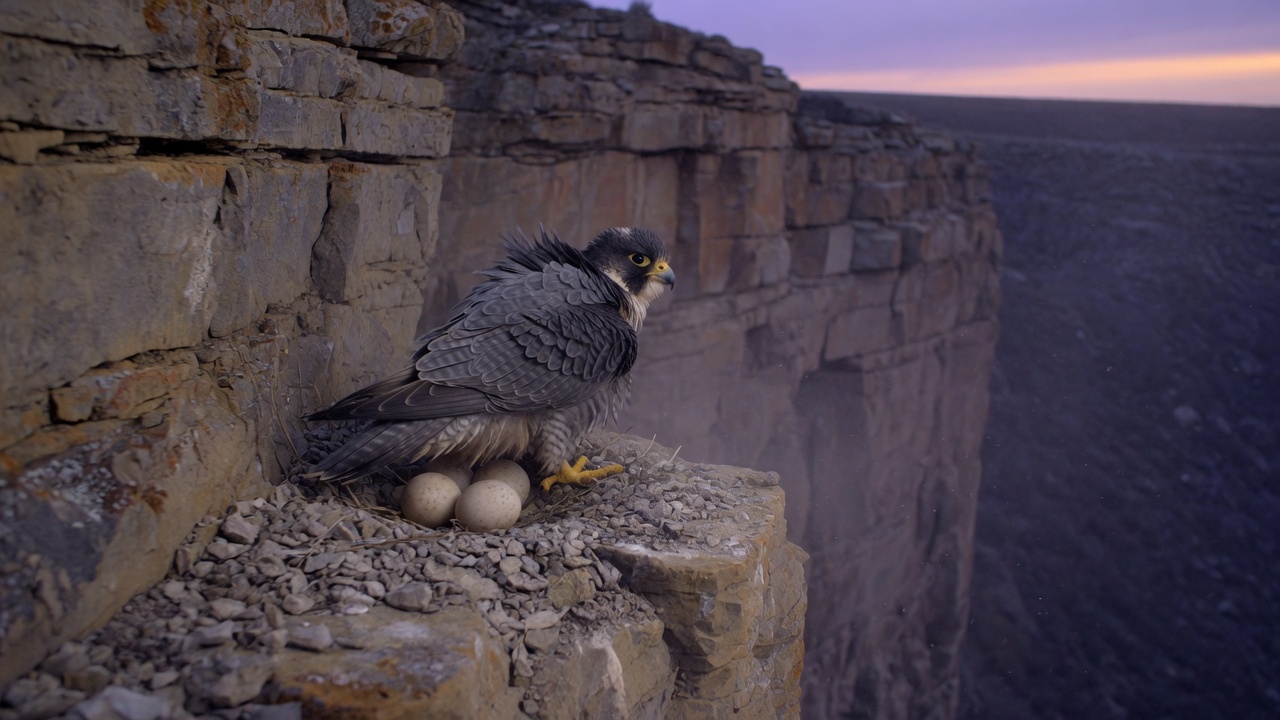
Peregrines required more than a ban. Tom Cade founded The Peregrine Fund at Cornell in 1970 to breed falcons in captivity and release them. Hacking—placing young birds at release sites and supplying food until they hunted—was refined in the mid-1970s. By the late 1990s, thousands of captive-raised peregrines had been released in North America. The eastern population, which had been extirpated as a breeder, nested again on cliffs and on the ledges of cities that had not existed as eyries in the nineteenth century. The American peregrine was removed from the federal endangered list in 1999. Cade and his colleagues were explicit: the releases would have been a gesture if DDT had remained in the food web at 1960s intensities.
Ospreys reoccupied coasts. Brown pelicans were delisted in stages. None of this means every affected population everywhere recovered on the same timetable. Residues remain in soils and sediments. Some local food webs still deliver DDE. Sensitivity varies. The directional fact is still the one that matters: when the input stopped, shells thickened, and numbers followed, often with a lag of years to decades.
It also suggests something Flying River will return to often: despair is not a scientific conclusion. The same world that produced a delayed harm produced a delayed repair.
The strongest objections
The first objection is public health. DDT remains, under the Stockholm Convention on Persistent Organic Pollutants, available for disease-vector control. Indoor residual spraying against malaria mosquitoes is not the same act as broadcasting the compound over American farmland. The World Health Organization has long held that DDT can still have a role where alternatives of equivalent operational feasibility are lacking, while also stating that it should be a last resort and that use has declined as other insecticides and bed nets have expanded. A magazine about hidden ecological costs does not get to pretend that malaria is a footnote. Established: agricultural DDT in temperate food webs produced well-documented raptor declines. Also established: malaria kills, and indoor spraying is a different exposure pathway, dose, and purpose. The honest position is not that the American cancellation proved indoor spraying unnecessary. It is that persistence and biomagnification do not become imaginary because a use is humanitarian.
The second objection is that raptors declined for other reasons: shooting, egg collecting, habitat loss, electrocution, later rodenticides. All of those are real. Egg collecting in Britain, as Newton and others have noted, could suppress local productivity for decades without erasing the breeding population the way the 1950s crash did. Shooting reduced eagles before DDT. Habitat still limits ospreys in developed estuaries. The thinning evidence does not require those pressures to have been imaginary. It requires them not to have produced a synchronized, continent-scale change in shell quality beginning in 1946–47, correlated with DDE, reversible after bans. They did not.
The third objection is mechanistic overreach: if the enzyme story shifted from carbonic anhydrase to prostaglandins, perhaps the whole case is unstable. That is not how physiology works. The phenotypic fact—DDE, sensitive species, thinner shells, more breakage—has been stable since the late 1960s. The intracellular account has been refined. Refinement is not acquittal.
The fourth objection is the one this publication is most tempted by, and must refuse: that DDT is a skeleton key for every later chemical controversy. It is not. Each substance has its own persistence, its own pathways, its own dose, its own substitutes. Some compounds thin shells; most do not. Some bioaccumulate; many do not. Honesty requires that we keep the method—follow the connection, distinguish evidence from suspicion—and refuse the laziness of a single parable.
What delay conceals
The bird was a sensor. It was not a philosopher. It accumulated what the landscape offered, and it failed at the point where reproduction is physically most brittle. We noticed because the species was charismatic, because egg collectors had accidentally built a baseline, and because a few scientists treated a broken shell as data rather than as weather.
Most delayed harms will not arrive with a peregrine. They will arrive as a slight shift in a rate, a residue in a core of sediment, a compound that is legal because the test that would have caught it was not required. You do not have to care about this because a campaign told you to. You can care because a load-bearing part of a system can fail while the system still photographs well.
Follow the connection far enough and the 1972 cancellation is not the end of the story. It is the moment a presence stopped being replenished. The molecules already in fat, soil, and lake mud did not read the Federal Register. Their decline in eggs and in populations is a clock, not a verdict that the clock has run out.
Sometimes the consequence is not obvious until something fails. Once it has failed in public view, we are not entitled to forget how it looked when it was still invisible.
Sources
- Ratcliffe, D. A. “Broken Eggs in Peregrine Eyries.” British Birds 51 (1958): 23–26.
- Ratcliffe, D. A. “Decrease in Eggshell Weight in Certain Birds of Prey.” Nature 215 (1967): 208–210.
- Ratcliffe, D. A. “Changes Attributable to Pesticides in Egg Breakage Frequency and Eggshell Thickness in Some British Birds.” Journal of Applied Ecology 7, no. 1 (1970): 67–115.
- Hickey, Joseph J., and Daniel W. Anderson. “Chlorinated Hydrocarbons and Eggshell Changes in Raptorial and Fish-Eating Birds.” Science 162, no. 3850 (1968): 271–273.
- Peakall, David B., and Lloyd F. Kiff. “Eggshell Thinning and DDE Residue Levels among Peregrine Falcons Falco peregrinus: A Global Perspective.” Ibis 121, no. 2 (1979): 200–204.
- Peakall, D. B., and L. F. Kiff. Contribution in Peregrine Falcon Populations: Their Management and Recovery, edited by Tom J. Cade, James H. Enderson, Carl G. Thelander, and Clayton M. White. Boise, ID: The Peregrine Fund, 1988.
- Miller, David S., William B. Kinter, and David B. Peakall. “Enzymatic Basis for DDE-Induced Eggshell Thinning in a Sensitive Bird.” Nature 259 (1976): 122–124.
- Lundholm, C. E. “DDE-Induced Eggshell Thinning in Birds: Effects of p,p’-DDE on the Calcium and Prostaglandin Metabolism of the Eggshell Gland.” Comparative Biochemistry and Physiology Part C 118, no. 2 (1997): 113–128.
- Newton, Ian. Population Ecology of Raptors. Berkhamsted: T. & A. D. Poyser, 1979.
- Newton, Ian, and I. Wyllie. “Recovery of a Sparrowhawk Population in Relation to Declining Pesticide Contamination.” Journal of Applied Ecology 29, no. 2 (1992): 476–484.
- Newton, Ian, I. Wyllie, and A. Asher. “Mortality from the Pesticides Aldrin and Dieldrin in British Sparrowhawks and Kestrels.” Ecotoxicology 1 (1992): 31–44.
- Newton, Ian. “Organochlorine Pesticides and Birds.” British Birds (and later reviews distinguishing DDE reproductive effects from cyclodiene adult mortality, including Newton 1986, 1998, 2017).
- Grier, James W. “Ban of DDT and Subsequent Recovery of Reproduction in Bald Eagles.” Science 218 (1982): 1232–1234.
- U.S. Environmental Protection Agency. “DDT Ban Takes Effect.” Press release, 31 December 1972; Ruckelshaus cancellation order of 14 June 1972.
- U.S. Fish and Wildlife Service. Bald eagle recovery and delisting materials (1963 survey of 417 breeding pairs in the lower 48; 2007 delisting, on the order of 9,789–10,000 pairs).
- The Peregrine Fund. Recovery history: Tom Cade, captive breeding and release; Interior Department delisting of the American peregrine falcon, 20 August 1999.
- Carson, Rachel. Silent Spring. Boston: Houghton Mifflin, 1962.
- Stockholm Convention on Persistent Organic Pollutants (adopted 2001, in force 2004), Annex B provisions on DDT for disease-vector control.
- World Health Organization. Position statements on DDT in indoor residual spraying for malaria vector control under the Stockholm Convention.
- U.S. EPA CADDIS. “The Case of DDT: Revisiting the Impairment.”
The bird did not know what DDT was. It only knew that something had changed.
Follow the connection
- Agriculture
- Insects
- Birds
- Eggs
- Population
What we know
- DDT was widely used as an insecticide in the mid-twentieth century.
- It persists in the environment and can concentrate in food webs.
- A well-established mechanism links DDT’s breakdown products to eggshell thinning in certain birds of prey.
- After use was restricted in many countries, some affected populations recovered with the help of legal protection and breeding programs.
What remains uncertain
- Not every species responded the same way; sensitivity varies.
- Legacy contamination still exists in soils and sediments.
- New persistent chemicals raise related questions that are not automatically answered by the DDT story.
What can we do?
You don't have to care about this because everyone else does. You can care because the evidence gives you a reason to.
- Treat the DDT story as a method, not only a memorial: ask how a substance moves after it leaves the sprayer.
- Support monitoring of persistent chemicals rather than assuming absence of news is absence of residue.
- Prefer products and policies that require persistence and bioaccumulation to be examined before scale.
Demonstration authors are fictional. The phenomena discussed are real subjects of public scientific literature and reporting. Sources named in the article are documented; this is not a comprehensive literature review.