Wildlife
The Whale We Cannot Hear
What happens when the ocean becomes louder
From the rail of a ship on a still day, the ocean can look like a vacancy. The surface is a plane. Wind is a texture. A distant swell arrives without a sound you would call a conversation. You hear the hull, a gull, perhaps a chain. You do not hear the animals that live below the waterline, and the absence of their voices is easy to mistake for an absence of life.
That mistake is a property of the interface, not of the sea. Air and water do not pass sound the way a window passes light. Most of what a whale says never reaches the deck. Most of what a propeller says never reaches a person on shore. The ocean is not silent. It is a medium in which sound is the long-distance sense, and in which human industry has, over a century and a half, become a continuous source.
The physics is not in dispute
Sound is a pressure wave. In air at sea level it travels on the order of three hundred and forty metres a second. In seawater it travels on the order of fifteen hundred metres a second—more than four times as fast—because water is both denser and far less compressible than air. NOAA’s ocean service puts the typical figures at about 340 metres per second in air and about 1,500 metres per second in seawater, and notes that low-frequency sound can travel hundreds of kilometres in the sea. Temperature, salinity, and pressure shift the speed by modest amounts; those modest amounts, stacked through a water column, bend rays and create ducts.
One such duct is the deep sound channel, historically called SOFAR, in which sound speed reaches a minimum at a depth that is often near a kilometre in mid-latitudes. Rays that leave the axis are refracted back toward it. Attenuation at low frequencies is small. Experiments have shown that sounds placed in the channel can be detected at basin scale: in 1960, 15-hertz signals from explosions off Perth were heard near Bermuda; later, the Heard Island Feasibility Test showed that 57-hertz transmissions could be received in both the Atlantic and the Pacific. Those are physics demonstrations, not a census of whale conversations. They establish a fact that matters for animals: the ocean is an acoustic space, and low-frequency energy does not stay local.
Light does. Below a thin sunlit layer, vision is a short-range sense. Marine mammals, fishes, and many invertebrates have evolved to use sound to find one another, to find food, to keep a calf, to assess a coastline, to detect a predator. NOAA Fisheries puts the point without ornament: cetaceans send and receive complex sounds to communicate, navigate, and forage; fish and invertebrates use sound for basic life functions as well. That is established biology, not a campaign slogan.
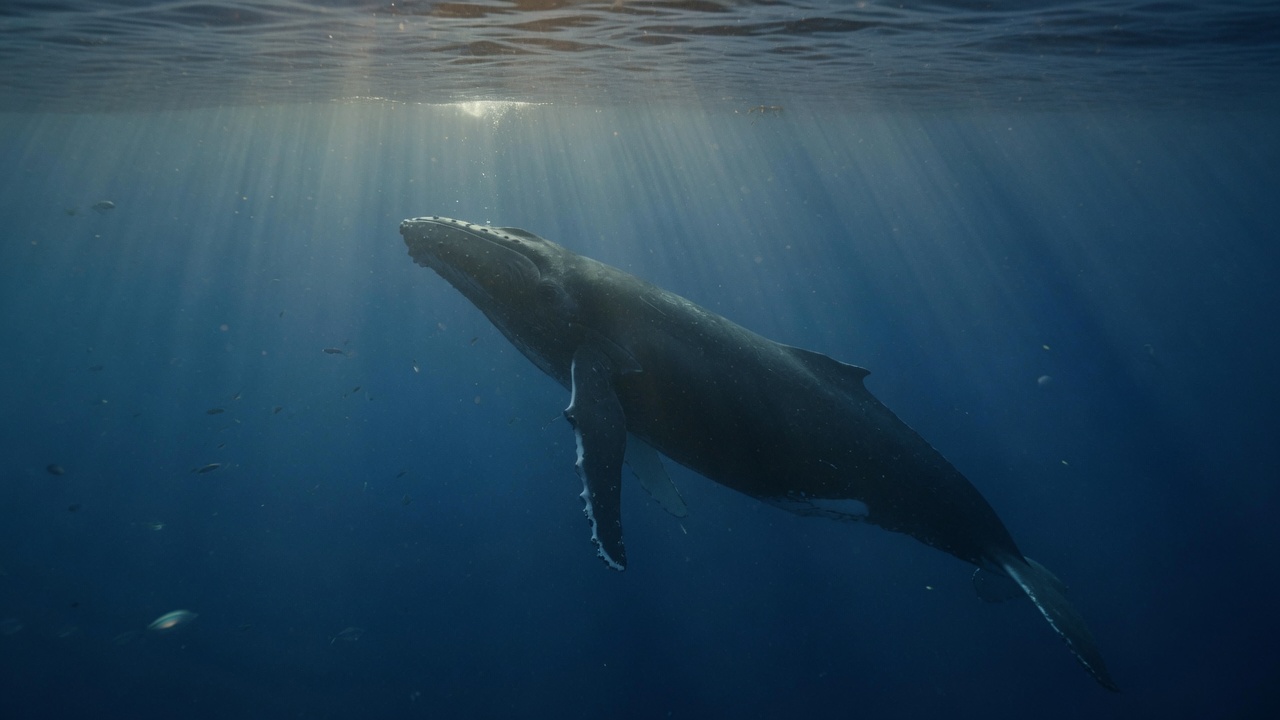
Humpback whales made the fact public. In the late 1960s, Roger Payne, working with recordings that included hydrophone material gathered off Bermuda by the navy engineer Frank Watlington, and with Scott McVay, showed that the long, patterned vocalizations of Megaptera novaeangliae were songs: sequences lasting on the order of seven to thirty minutes, then repeated with considerable precision, sometimes for hours. Payne and McVay published the analysis in Science in 1971. The 1970 album Songs of the Humpback Whale put the same material into living rooms. The conservation consequence was real and is a matter of history: the recordings helped build public support for restrictions on commercial whaling. The scientific consequence was equally real. A large animal that most people would never see had a structured acoustic life, and that life occupied frequencies a person could hear if a hydrophone, rather than a pair of ears on a deck, was the instrument.
Baleen whales generally specialize in low frequencies. Toothed whales add high-frequency echolocation. The details differ by species, by call type, by season, by whether an animal is feeding or migrating or tending a calf. The common premise does not. In water, hearing is not a luxury. It is how a body that cannot see far still inhabits a large world.
A louder ocean
The natural ocean is not a library. Wind, waves, rain, ice, earthquakes, and the animals themselves produce a soundscape that changes with weather and with season. What has changed since the industrial age is the addition of a persistent human layer.
John Hildebrand, in a 2009 review in Marine Ecology Progress Series, divided the ambient field into bands. The low-frequency band, roughly 10 to 500 hertz, is now dominated by anthropogenic sources: primarily commercial shipping, secondarily seismic exploration. Those sources contribute across ocean basins because low-frequency sound experiences little attenuation. Over the preceding decades, he wrote, the shipping contribution to ambient noise had increased by as much as 12 decibels, coincident with a significant increase in the number and size of vessels in the world’s commercial fleet.
A 12-decibel rise is not a small change in the way a 12-percent rise in a price is small. The decibel is logarithmic. An increase of 10 decibels is a tenfold increase in acoustic intensity. Mark McDonald, Hildebrand, and Sean Wiggins compared recordings west of San Nicolas Island, California, in 2003–2004 with measurements at the same site in 1964–1966. Ambient levels at 30–50 hertz were 10–12 decibels higher in the later period, an average rise of about 2.5 to 3 decibels per decade in that band. They noted that the number of commercial vessels roughly doubled between 1965 and 2003 while gross tonnage quadrupled. The attribution of the low-frequency rise to shipping is the standard reading of those data. It is not a claim that every ocean, at every frequency, has grown louder at the same rate. Some later analyses have found flattening or even declines in particular regions and bands. The Northeast Pacific record remains one of the clearest long comparisons we have, and it is enough to establish the direction of the industrial change.
The fleet has continued to grow. UNCTAD’s Review of Maritime Transport 2024 put world fleet capacity at about 2.4 billion deadweight tons, with growth of 3.4 percent in 2023—below the long-term average of the boom years, still an expansion of the machines that put low-frequency energy into the sea. Seaborne trade, in the same report, was on the order of twelve billion tons. Those are cargo numbers, not noise maps. They are the reason the noise maps keep needing to be redrawn.
Carlos Duarte and colleagues, writing in Science in 2021, described the soundscape of the Anthropocene ocean as fundamentally different from that of preindustrial times: more anthrophony from shipping, resource exploration, and infrastructure; less biophony where hunting, fishing, and habitat degradation have reduced the animals that used to fill the band; geophony altered by climate through ice and storms. That is a synthesis, not a single measurement. It is the right frame. The ocean did not become noisy in one year, and it did not become noisy in only one way.
Four kinds of noise, not one
Public argument often treats “ocean noise” as a single insult. The physics and the animals do not.
Shipping is continuous, or near enough to continuous on the busy routes, and concentrated at low frequencies. Propeller cavitation—the collapse of bubbles on a turning blade—is the principal source of underwater radiated noise from a typical merchant ship, with hull flow and machinery contributing. The sound of a large vessel is not a bang. It is a rumble that moves with the ship and that, multiplied by the fleet, becomes a raised floor under the frequencies baleen whales use to call.
Seismic surveys for oil and gas use arrays of airguns that release compressed air to produce impulsive, low-frequency pulses, repeated on the order of every ten to fifteen seconds for days or weeks, so that the returning echoes can map strata kilometres down. Hildebrand treated seismic exploration as the second major contributor to the low-frequency ambient field, with basin-scale reach. These pulses are among the loudest sounds that people put into the water on a regular schedule. That is a statement about source level and repetition, not a statement that every survey has been shown to kill whales. The distinction matters, and it will matter again when the subject is offshore wind.
Military sonar, particularly mid-frequency active sonar used to find submarines, occupies a different band and a different literature. The concern is not a raised floor so much as intense, directed pulses and the animals that hear them well. Multiple mass strandings of beaked whales have been associated in time and place with naval exercises using mid-frequency active sonar. The 2000 event in the Bahamas is among the best documented. Reviews by D’Amico and others, and later pathological work including Bernaldo de Quirós and colleagues, have treated the association as more than coincidence for ziphiids in particular. The mechanism is still argued: behavioral response leading to decompression-like injury is a leading hypothesis, not a closed case. What is established is that some sonar exposures have been followed by strandings of species that are otherwise rarely found on beaches, and that navies and regulators treat the risk as real enough to manage.
Pile driving—the hammering of foundation piles into the seabed for bridges, harbors, and offshore wind turbines—is impulsive, local compared with a basin-scale airgun survey, and extremely loud in the near field. It is a construction sound. It has a start and, if the project ends, a stop. It is not the same object as the continuous rumble of a shipping lane, and it is not the same object as a navy sonar exercise. Harbor porpoises and other small cetaceans have been shown to leave areas during pile driving; mitigation, including seasonal pauses and bubble curtains, exists because the displacement is documented. Whether a given project’s construction noise becomes a population problem is a separate, harder question.
Other sources belong on the list without crowding the main four: explosives, dredging, icebreaking, small craft, acoustic deterrent devices, and the high-resolution geophysical tools used to map a cable route. Each has a frequency, a duty cycle, a footprint. Animals do not experience “noise.” They experience a particular masker at a particular time in a particular habitat.
Masking is a geometry problem
When two sounds occupy the same band at the same time, the quieter one can disappear into the louder one. Acoustic masking is not a metaphor. Christopher Clark, William Ellison, Brandon Southall, and colleagues set out, in 2009, a way to quantify it for free-ranging whales: an animal’s communication space is the area over which a call could be detected by a conspecific under a given noise condition; masking is the portion of that space lost when the noise rises. They mapped the idea for singing fin and humpback whales and for calling North Atlantic right whales. Later work in Stellwagen Bank National Marine Sanctuary, including Danielle Cholewiak and colleagues, found that under contemporary ambient and vessel conditions, some baleen-whale signals could lose most of their modeled communication space relative to a quieter reference.
The reference is a problem. Clark’s group used a statistical floor—something like the quietest fifth of measured conditions—as a stand-in for a quieter ocean. No one has a calibrated hydrophone record of the pre-industrial North Atlantic. The pre-industrial baseline is unknown in the strict sense. That does not make masking a fantasy. It means that every percentage of “lost space” is a comparison with a chosen quiet, not with 1800.
Animals are not passive victims of a spectrogram. They compensate, up to a point. The Lombard effect—raising the voice as the room gets louder—has been measured in several cetaceans. Marla Holt and colleagues showed that Southern Resident killer whales increased call amplitude by about one decibel for every one-decibel increase in background noise, at least over the range they sampled. Andrew Foote, Richard Osborne, and A. Rus Hoelzel found that killer whales in the inshore waters of Washington State produced longer calls in the presence of boats, but only in recordings made after boat traffic had increased. Susan Parks, Clark, and Peter Tyack documented that North Atlantic and South Atlantic right whales produced calls with a higher average fundamental frequency, and called at a lower rate, in high-noise conditions; later, Parks showed that individual North Atlantic right whales increased call amplitude as background noise rose. Humpbacks in Glacier Bay have been reported to raise amplitude and to call less often as vessel noise increases.
Compensation is not free. Calling louder costs energy. Calling less often, or waiting for a quiet window, costs opportunities. Shifting frequency may move a signal out of a masker and also out of the band a receiver is listening in. None of those trade-offs has been fully priced at the population level for any large whale. The behavioral facts are established. Their demographic meaning is not.
There is a physiological observation that sits between behavior and demography. Rosalind Rolland, Parks, and colleagues measured glucocorticoid metabolites in the feces of North Atlantic right whales in the Bay of Fundy. After 11 September 2001, large-vessel traffic in the bay fell. Underwater noise dropped by about 6 decibels, with a significant reduction below 150 hertz. Baseline faecal glucocorticoids were lower in that quieter window than in subsequent Septembers when traffic had returned. The authors presented this as the first evidence that exposure to low-frequency ship noise may be associated with chronic stress in whales. It is a natural experiment with a small, opportunistic sample. It is not a dose–response curve for the species. It is also not nothing. A hormone change in an endangered animal, coincident with a measured drop in the noise that overlaps its calls, is a reason to take masking and stress as linked questions rather than as separate files.
Displacement, silence, and the animals that leave
Not every response is a louder call. Some animals stop calling. Some leave.
Seismic surveys have been associated with changes in singing and in local presence for several baleen whales. Manuel Castellote and colleagues reported that fin whales altered song and that singing activity declined in association with seismic activity in the Mediterranean. Salvatore Cerchio and colleagues reported that humpback song activity off Angola declined during days of seismic survey. Lucia Di Iorio and Clark found that blue whales in the St. Lawrence increased calling during a seismic survey, a result often read as compensation rather than as comfort. Bowhead whales have a long record, from the Alaskan Beaufort Sea, of changing calling rates and of avoiding the area around active airgun arrays, with the details depending on received level and on whether the animals are migrating or feeding. The literature is not a single arrow. It is a set of documented changes, some of which look like leaving, some like shouting, some like waiting.
Military sonar has produced some of the starkest displacement data we have, in part because the experiments were designed. Beaked whales tagged in controlled exposure studies, including work led by Tyack, have shown strong avoidance of mid-frequency sonar at received levels well below those that would be expected to cause direct tissue damage. The animals dive differently. They leave. If the place they leave is a feeding slope, the lost hours are a foraging cost even if no body washes up.
Shipping can displace as well as mask. The effect is often subtler: a change in surfacing, a change in heading, a pause in foraging as a vessel passes. Southern Resident killer whales have a particularly closely watched literature, because the same waters hold the whales, the salmon they eat, and a dense mixture of commercial and recreational traffic. Foraging reductions in the presence of vessels have been reported repeatedly. Whether those lost minutes, accumulated across a season, help explain a population that has not recovered is a question on which reasonable scientists still spend their careers. It is probable that chronic disturbance and masking contribute to the difficulty of a food-limited, small population. It is not established that noise, isolated from salmon abundance and contaminants, is the binding constraint.
What is established, probable, and unknown
Flying River will not flatten this into a single verdict.
Established. Sound travels farther and faster in water than in air. Whales and many other marine animals use sound to communicate, navigate, and forage. Human sources have added noise to the ocean, especially at low frequencies along shipping routes and during seismic and construction operations. Some species, in some places, have been shown to call more loudly, to call less often, to shift frequency, to stop singing, or to leave an area in response to particular sounds. Some sonar exercises have been associated with beaked-whale strandings. Masking of communication space is a physically coherent, empirically modeled process.
Probable. For some species in some habitats, those behavioral and physiological changes are costly enough to matter: lost foraging, chronic stress, reduced contact between mother and calf, missed mates. Right whales calling through a shipping lane, killer whales hunting in a boat wake, porpoises leaving a pile-driving site for weeks—these are not parlor tricks. The probability that they are demographically irrelevant is low. The probability that they are the sole explanation for any large-whale decline is also low.
Unknown. The pre-industrial acoustic baseline. The population-level accounting that would turn a lost kilometre of communication space, or a 6-decibel quieter week, into a change in survival or calving. The cumulative effect of many moderate sources, none of which would be dramatic alone. The share of a given mortality event that belongs to noise rather than to a ship’s hull, a fishing line, a shifting prey field, or a disease. We do not have a global ledger in which ocean noise is shown to have collapsed a whale population by itself, and this magazine will not write as if we did.
The International Maritime Organization has treated the shipping part of the problem as real enough to write guidance. In 2014 it issued voluntary guidelines for the reduction of underwater noise from commercial shipping; in July 2023, at MEPC 80, it approved a revision, circulated as the 2023 guidelines, that recognizes commercial shipping as a main contributor to underwater radiated noise with adverse effects on marine life, including marine mammals, fish, and invertebrates. The document offers design and operational measures—hull and propeller, cavitation, maintenance, speed, routing—and templates for a noise management plan. It is not a binding limit. Uptake is the open question. Classification societies have quiet-ship notations. Some ports have begun to treat noise as they treat emissions: a thing that can be measured and, in principle, priced. The physics of a quieter propeller is not mysterious. The politics of slowing a fleet, or of paying for a better one, are another medium.
NOAA’s Ocean Noise Strategy, and the agency’s Ocean Acoustics Program, exist because the United States’ marine-mammal statutes require the government to take the acoustic habitat seriously even when the population model is incomplete. Passive acoustic monitoring has become a standard tool: listening as census, listening as management. That is progress of a particular kind. We are better at hearing the whales than we were when Payne and McVay sat with a spectrograph. We are also better at making the water they sing in a busier place.
The rail and the hydrophone
Return to the quiet day at the rail. The quiet was never a fact about the water. It was a fact about you. A hydrophone lowered from the same ship would not report a vacancy. It would report a weather of engines, a weather of snapping shrimp if you were in the warm shallows, a weather of ice if you were not, and, if you were lucky and in the right season, a phrase of song that had already travelled farther than the eye can see from the wheelhouse.
The editorial error is to treat that song as a soundtrack—something added for the benefit of a documentary, something optional. It is not optional to the animal. It is the animal’s map, its social life, its hunt. The editorial error in the other direction is to treat every human sound as a proven extinction pressure. The ocean has always had storms. It has not always had a continuous grid of propellers, a seasonal lattice of airguns, a navy’s need to hear a submarine, and a coastline that is being rebuilt, pile by pile, for energy and for trade.
What we can say without borrowing certainty is simple, and it is enough to think with. The medium favors sound. We have raised the floor in the band where many of the largest animals speak. They have answered, in the ways we can measure, by shouting, by waiting, by leaving, and, in one well-placed week in the Bay of Fundy, by showing a quieter hormone profile when the ships thinned. Whether those answers scale to a population is the work that is still open. The work that is not open is the physics. You cannot unhear a hydrophone once you have listened. The whale you cannot hear from the rail was never the whale that was not there. It was the whale whose world does not end at the surface, and whose surface, unlike ours, is not the place where sound goes to die.
Sources
- Payne, Roger S., and Scott McVay. “Songs of Humpback Whales.” Science 173, no. 3997 (1971): 585–597.
- NOAA National Ocean Service. “Basics of Underwater Sound.” Programmatic EIS fact sheet for surveying and mapping in U.S. waters.
- NOAA Fisheries. “Ocean Noise.” https://www.fisheries.noaa.gov/national/science-data/ocean-noise
- NOAA. Ocean Noise Strategy Roadmap. 2016.
- Hildebrand, John A. “Anthropogenic and Natural Sources of Ambient Noise in the Ocean.” Marine Ecology Progress Series 395 (2009): 5–20.
- McDonald, Mark A., John A. Hildebrand, and Sean M. Wiggins. “Increases in Deep Ocean Ambient Noise in the Northeast Pacific West of San Nicolas Island, California.” Journal of the Acoustical Society of America 120, no. 2 (2006): 711–718.
- Duarte, Carlos M., et al. “The Soundscape of the Anthropocene Ocean.” Science 371, no. 6529 (2021): eaba4658.
- Clark, Christopher W., et al. “Acoustic Masking in Marine Ecosystems: Intuitions, Analysis, and Implication.” Marine Ecology Progress Series 395 (2009): 201–222.
- Cholewiak, Danielle, et al. “Communicating Amidst the Noise: Modeling the Aggregate Influence of Ambient and Vessel Noise on Baleen Whale Communication Space in a National Marine Sanctuary.” Endangered Species Research 36 (2018): 59–75.
- Parks, Susan E., Christopher W. Clark, and Peter L. Tyack. “Short- and Long-Term Changes in Right Whale Calling Behavior: The Potential Effects of Noise on Acoustic Communication.” Journal of the Acoustical Society of America 122, no. 6 (2007): 3725–3731.
- Parks, Susan E., et al. “Individual Right Whales Call Louder in Increased Environmental Noise.” Biology Letters 7, no. 1 (2011): 33–35.
- Holt, Marla M., et al. “Speaking Up: Killer Whales (Orcinus orca) Increase Their Call Amplitude in Response to Vessel Noise.” Journal of the Acoustical Society of America 125, no. 1 (2009): EL27–EL32.
- Foote, Andrew D., Richard W. Osborne, and A. Rus Hoelzel. “Whale-Call Response to Masking Boat Noise.” Nature 428 (2004): 910.
- Rolland, Rosalind M., et al. “Evidence That Ship Noise Increases Stress in Right Whales.” Proceedings of the Royal Society B 279, no. 1737 (2012): 2363–2368.
- Castellote, Manuel, Christopher W. Clark, and Marc O. Lammers. “Acoustic and Behavioural Changes by Fin Whales (Balaenoptera physalus) in Response to Shipping and Airgun Noise.” Biological Conservation 147, no. 1 (2012): 115–122.
- Cerchio, Salvatore, Samantha Strindberg, Tim Collins, Chanda Bennett, and Howard Rosenbaum. “Seismic Surveys Negatively Affect Humpback Whale Singing Activity off Northern Angola.” PLoS ONE 9, no. 3 (2014): e86464.
- Di Iorio, Lucia, and Christopher W. Clark. “Exposure to Seismic Survey Alters Blue Whale Acoustic Communication.” Biology Letters 6, no. 1 (2010): 51–54.
- Tyack, Peter L., et al. “Beaked Whales Respond to Simulated and Actual Navy Sonar.” PLoS ONE 6, no. 3 (2011): e17009.
- Bernaldo de Quirós, Yara, et al. “Advances in Research on the Impacts of Anti-Submarine Sonar on Beaked Whales.” Proceedings of the Royal Society B 286 (2019): 20182533.
- International Maritime Organization. Revised Guidelines for the Reduction of Underwater Radiated Noise from Shipping to Address Adverse Impacts on Marine Life. MEPC.1/Circ.906, 2023. (Revising the 2014 guidelines, MEPC.1/Circ.833.)
- UNCTAD. Review of Maritime Transport 2024. Geneva: United Nations.
- Munk, Walter, et al. The Heard Island Feasibility Test and related SOFAR-channel transmission studies; Perth–Bermuda 1960 transmission as reviewed in standard oceanographic accounts (e.g., Stewart, Introduction to Physical Oceanography).
- Roberts, Sam. “Roger Payne, Biologist Who Heard Whales Singing, Dies at 88.” New York Times, 14 June 2023.
We measure what we can hoist onto a boat. Whales live in what we cannot easily graph.
Follow the connection
- Ship traffic
- Underwater noise
- Whale communication
- Behavior
What we know
- Sound travels efficiently in water; many marine mammals rely on it to communicate, navigate, and find food.
- Shipping, sonar, and construction introduce additional underwater sound.
- Animals have been observed changing vocal behavior, avoiding areas, or showing stress responses in noisier conditions.
- Measuring those effects in the wild is difficult.
What remains uncertain
- Which behavioral changes reduce survival or reproduction is often unclear.
- Baseline soundscapes from before industrial shipping are incompletely known.
- The difference between a temporary displacement and a population-level harm is not always established.
What can we do?
You don't have to care about this because everyone else does. You can care because the evidence gives you a reason to.
- Support quieter ship design and speed reductions in sensitive habitats when evidence suggests they lower noise.
- Treat marine construction as an acoustic event, not only a visual one.
- Fund monitoring that lasts longer than a news cycle.
- Ask what a project sounds like underwater, not only what it produces on the surface.
Demonstration authors are fictional. The phenomena discussed are real subjects of public scientific literature and reporting. Sources named in the article are documented; this is not a comprehensive literature review.