Good News
The Species That Came Back
What recovery looks like when it is slow, legal, and incomplete
Extinction is silent. Recovery is bureaucratic, veterinary, and occasionally airborne.
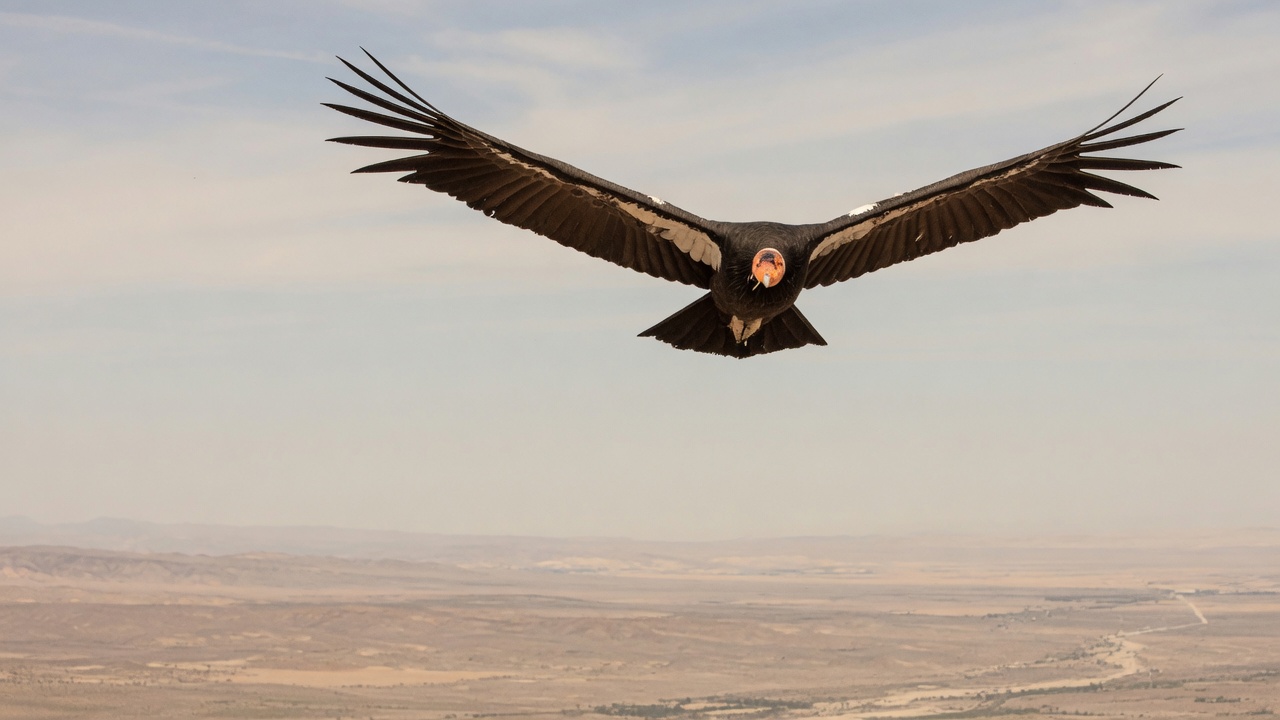
A California condor does not look like a meeting. In the air it is a nine-and-a-half-foot interruption of the sky, a bird so large that first-time viewers sometimes refuse the identification. On the ground it is a file: a studbook number, a transmitter, a blood-lead result, a necropsy, a permit, a release-site protocol written by people who will not live long enough to see whether the protocol was enough. That is not a reason to sneer at the file. That is how a large scavenger returns to a mountain that had forgotten the shape of its wings.
The public likes recoveries that feel like resurrection. Condors, eagles, an island kestrel, a whale that was hunted and then counted upward: these are the flagships. Flagships are useful and dangerous. They are useful because they make a method visible. They are dangerous because they invite a reader to treat one rising curve as a completed ecosystem. Flying River will print the curve. It will also print the asterisks. A count that rose from the low twenties to the mid-five-hundreds is not a count that rose to the Pleistocene. Some recoveries are geographically limited, expensive, and still dependent on captive rooms. Some are wilder than they look. Some look wilder than they are. The hidden force is not magic. It is coordinated restraint plus care: people deciding not to do a thing, and other people doing a tedious thing for a long time.
Twenty-two, then twenty-seven, then none in the sky
By 1982 it was possible, for the first time, to census the remaining California condors with something like completeness. Photographers and biologists, working the ridges of southern California, put the wild population at about twenty-two birds—NPS and recovery-program timelines use that figure; a photo census that year has also been reported as twenty-one known individuals. Either way the direction was not a mystery. From late 1982 to the mid-1980s the known wild flock fell in ugly annual steps: twenty-one, nineteen, fifteen, nine. Average mortality exceeded anything the species’ slow reproduction could offset. Condors do not breed until about six years of age and typically raise one chick every year or two. A 25 percent annual death rate is not a dip. It is an ending.
A captive program had already begun. Eggs were taken from wild nests in the hope that pairs would recycle, which they often did. Chicks hatched at the San Diego and Los Angeles zoos. The remaining wild birds kept dying, including from lead. In 1985 the U.S. Fish and Wildlife Service decided that the last free-flying condors would be trapped. The National Audubon Society sued to stop the captures. Native groups objected. The legal and political arguments were real: a species extinct in the wild is a species that exists only as long as institutions do. The Service won the argument that a wild remnant dying at that rate was not a wild population; it was a delay. The last wild condor, AC-9, was captured on Easter Sunday, 19 April 1987. The entire world population was then twenty-seven birds—thirteen males and fourteen females—in two southern California breeding facilities. For five years the species did not exist outside cages, barns, and the minds of the people who fed them.
Captive breeding worked faster than the gloom had allowed. Condors proved willing to reproduce in confinement. Double-clutching, puppet-rearing, and parent-rearing all entered the toolkit. Releases back to the wild began in 1992 in California, then at the Vermilion Cliffs in Arizona, then in Baja California, then, much later, in the Pacific Northwest with the Yurok Tribe and Redwood National Park. AC-9 himself was eventually released again. The studbook became a civilization in miniature: who is related to whom, who cannot be paired, who has been treated for lead and sent back out.
The count that is allowed to be boring
The California Condor Recovery Program issues an annual status sheet. It is not written for a magazine. That is why it is the right document. As of 31 December 2024, the Service reported a total world population of 566 condors (561 at the end of 2023; 564 at the end of 2022). The wild free-flying population was 369 (344 the year before; 350 the year before that). The wild birds were not one flock. Arizona/Utah held 89; California 214, of which 101 were in the southern flock and 113 in the central; the experimental Pacific Northwest population held 18; Baja California held 48. The captive population was 197, including breeding birds, exhibit birds, pre-release chicks, and birds that will never be released. Fifty-four captive pairs laid 65 eggs. Fifty chicks were available for 2025 placement.
Sixteen chicks fledged in the wild in 2024—three in Arizona/Utah, twelve in California, one in Baja, none yet in the Northwest. Fifty-six captive-reared condors were released the same year. Read those two numbers together. Wild production is no longer a curiosity. It is also not yet the engine. The three-year averages on the Service’s own charts still show releases and deaths larger than wild fledging. A population that grows because zoos keep sending adolescents is not a failure. It is not, yet, a population that sustains itself.
Thirty-five wild free-flying condors died in 2024, or were classed with the dead: twenty-five in Arizona/Utah, eight in California, two in Baja. Ten were missing. Five awaited necropsy. Lead poisoning killed eleven, all of them in the Arizona/Utah flock. In 2023 the same region had lost twenty-one birds to highly pathogenic avian influenza—an outbreak that flattened a year of growth and is now visible as a notch in the Arizona count. Fire, power lines, shooting, predation, and drowning remain on the pie chart. The pie chart’s dominant slice has not changed.
The metal that is still winning
From 1992 through 2024, the Service counted 151 deaths from lead poisoning in the wild free-flying population. Lead accounted for 49 percent of 308 deaths with a known cause, and 28 percent of 534 total deaths, including the unknowns. That is the leading known cause, and it has been the leading known cause for as long as the reintroduction has had a necropsy program. The pathway is not mysterious. Condors are scavengers. They feed on carcasses and gut piles. Hunters who use lead bullets leave fragments in the meat at a scale the bird’s stomach is built to process. A fragment that would not trouble a human diner can put a condor into treatment or a freezer.
California phased lead ammunition out of wildlife hunting in stages and completed a statewide ban in 2019. Arizona and Utah have incentive and education programs and some restrictions; they do not have California’s rule. The 2024 lead deaths clustering in Arizona/Utah, with none attributed that year in the California flocks, is a single year’s geography, not a completed experiment. A 2026 analysis in Nature Communications reported that blood-lead exposure and lead-related mortality in the California flocks have not simply faded with the ban, and that the California flocks’ growth rate, if captive releases are excluded, sits below replacement. The authors point to remaining illegal or out-of-state lead, and to wild-pig hunting as a correlated source. Baja California, in the same analysis, has had very low blood-lead levels and essentially no lead mortality—and an increasing population even without counting releases. That contrast is the most hopeful sentence in the lead literature, and it is also an indictment. The toxin is optional. The birds in California are still eating it.
Veterinary chelation, trapping, and treatment pull some poisoned birds back from the edge. That work is why the death list is not longer. It is also why “wild” is a managed word. A condor that is caught twice a year, tested, injected, and released is a wild bird in the sense that it flies and forages. It is not wild in the sense that the public imagines when it sees a silhouette over a canyon and feels that nature has healed. Both senses can be true. Only one of them is a recovery goal. The recovery plan’s remaining unfinished objective is to reduce mortality enough that the flocks hold without the truck from the zoo. Four of five plan elements have been met, program biologists have said in public briefings. The fifth—the deaths—has not.
Self-sustaining, in this context, is a demographic claim, not a spiritual one. It means that births in the wild, minus deaths in the wild, would keep the flock above a recovery threshold without regular imports from captivity. The 2024 sheet is not there. Sixteen wild fledglings against thirty-five deaths and fifty-six releases is a program that is still a program. Individual-based models of the California flocks make the same point in a different grammar: hold lead constant and halt reinforcements, and the simulated population falls; cut lead and keep reinforcements, and it rises. The range between those futures is the range of a policy choice, not of fate. HPAI in 2023 was a reminder that a new pathogen can take a year away regardless of ammunition. Slow breeders do not have spare years.
An eagle, a kestrel, an island without rats
The condor is the slow case. Other recoveries ran on different clocks and should not be mashed into one moral.
The bald eagle, listed in the lower forty-eight under the Endangered Species Preservation Act in 1967, had fallen to 417 known nesting pairs in 1963 by the Service’s most-cited survey, or about 487 in the 2007 delisting rule’s slightly different accounting. DDT thinned eggs. Shooting and habitat loss did the rest. After the 1972 cancellation of most DDT uses, and under the Endangered Species Act, the Bald and Golden Eagle Protection Act, and a great deal of unglamorous nest-watching, the population climbed. The Service estimated 9,789 breeding pairs in the contiguous United States at delisting in 2007. Estimates based on 2018–2019 data put about 316,700 individuals in the lower forty-eight, including more than 71,000 breeding pairs. Lead still kills eagles. Wind turbines, vehicles, and poisoned carcasses still kill eagles. The bird is no longer in danger of disappearing from the map of the lower forty-eight. That is the claim. It is large enough without embroidery.
The Mauritius kestrel is the island case, and it is the case that most tempts a happy ending too early. In 1974 only four birds were known in the wild, including a single breeding pair. Habitat had been cut to fragments. DDT and other insecticides had thinned the food web and the shells. Carl Jones, arriving to what some colleagues considered a closing-down brief, built a program of egg-pulling, captive breeding, nest boxes, supplementary feeding, and predator control. Hundreds of kestrels were released. By the late 1990s the population had risen to a peak later estimated in the range of 350–500 individuals—earlier, more exuberant figures of 800–1,000 were revised down. The IUCN downlisted the species to Vulnerable, then uplisted it to Endangered again in 2014 as the western population declined. The Mauritian Wildlife Foundation’s recent monitoring puts the island total around 250–300 birds. The recovery from four is real. The plateau, and the later slide in some subpopulations, is also real. Limited native forest cannot hold an unlimited kestrel. A species can be saved from extinction and still not be safe.
Island eradications belong in the same paragraph because they are the unromantic cousin of captive breeding. Rats, mice, cats, and goats have ended more island endemics than any oration. South Georgia’s rodent eradication, completed in the mid-2010s across a sub-Antarctic island the size of a small country, is among the largest ever attempted: helicopters, bait, and a waiting period to see whether a single survivor had been missed. Macquarie, islands of New Zealand, and others have been cleared with poison, dogs, and years of checking. Petrels and pipits that nested on the ground began to nest on the ground again. The asterisk here is invasion biology’s usual asterisk: one landing of a pregnant rat can reset the clock. Success is a biosecurity budget, not a plaque. It is also, unlike a condor, a recovery that does not require the recovered animals to sit still for a blood test. Remove the introduced mammal and the native birds, if any remain, often do the rest. That is a different method from a studbook, and it is worth naming so that “species recovery” does not collapse into a single image of a zoo.
A whale that came back, and a whale that did not
Gray whales split the difference between a delisting party and a continuing emergency, depending on which ocean you mean.
Commercial whaling drove Eschrichtius robustus near extinction in the eastern North Pacific. Protection, and the end of the relevant hunt, allowed the eastern stock to rebound. In 1994 the National Marine Fisheries Service removed the eastern North Pacific population from the Endangered Species Act list while retaining the western North Pacific (Korean) population as endangered. The eastern animals had returned to something near the estimated pre-whaling abundance; the western animals had not. That geographic split is the whole lesson. A species is not a single number.
Eastern counts rose into the mid-twenty-thousands, with a 2015/2016 estimate near 26,960. Then the ocean changed its mind, or the whales did. NOAA declared an Unusual Mortality Event for 2019–2023. Strandings ran high from Mexico to Alaska. Many carcasses were thin. The working interpretation has been nutritional: a warming, shifting Arctic foraging ground, not a return of Yankee whaling. Southbound counts fell by on the order of 40 to 50 percent from the 2015–2016 peak. The UME was closed in 2023 as strandings returned toward baseline. The population remains in the tens of thousands, not in the hundreds, and it has dropped before—there was another UME in 1999–2000—and risen after. It is not a completed safety. It is also not an extinction trajectory of the condor type.
The western North Pacific animals are a different file. Photo-identification and genetics describe a small population, on the order of a couple of hundred or fewer animals using western waters, some of which also appear on the eastern migratory path, complicating the old map. IUCN downlisted the western gray whale from Critically Endangered to Endangered in 2018 after mature numbers were judged to have exceeded fifty and growth was positive. Fifty is not a crowd. Oil and gas off Sakhalin, ship strikes, nets, and a small gene pool remain. Do not put a western gray whale in a sentence that is really about the eastern recovery. The asterisk is the animal.
What “came back” is allowed to mean
A species that came back did not come back to a world that had been waiting, unchanged, with its old carcasses, its old cliffs, and its old silence. It came back to power lines, lead, influenza, a hotter Bering Sea, a Mauritius with 1 percent of its native forest, a river of tourists at an eagle nest. Recovery programs are often accused of manufacturing a wilderness pageant. Sometimes they do. More often they manufacture a second chance that still requires a budget.
The condor’s 566 is a genuine second chance. So is the eagle’s 70,000 pairs, the kestrel’s hundreds, the eastern gray whale’s still-large migration. None of these is a warrant that extinction has gone out of fashion. The background rate of loss continues in less photogenic taxa: insects without a studbook, freshwater mussels, plants that never make a banner. Island birds without a Carl Jones go quiet. A flagship can draw money toward a species that already has a constituency and away from one that does not. That allocation problem is real. It does not make the condor fictional.
What most people cannot easily see, standing under a condor, is the ratio of wild fledglings to captive releases, the 49 percent, the missing birds, the Baja contrast that says lead is a choice. Follow that ratio far enough and the romantic question—did the species come back?—becomes a management question: under what continuing labor does the count stay up? The labor is unfashionable: ammunition rules that hold, necropsies that are funded, a zoo that keeps a breeding pair when the public has moved on, a rat-dog on an island, a survey flown in January gray light. Extinction is silent because nobody is left to make a sound. Recovery is noisy with clipboards. That noise is the hope. It is not a feeling. It is a practice that has, in a few documented cases, put a shadow back on the rock.
Sources
- U.S. Fish and Wildlife Service, California Condor Recovery Program. 2024 Annual Population Status. As of 31 December 2024. Hopper Mountain National Wildlife Refuge Complex.
- Snyder, Noel F. R., and Helen Snyder. The California Condor: A Saga of Natural History and Conservation. Academic Press / related USGS staff summaries of the 1982–1987 captures (wild low near 22 in 1982; 27 birds in captivity after 19 April 1987).
- National Park Service. “California Condor Reintroduction & Recovery.” (22 birds in 1982; last wild bird captured 19 April 1987.)
- California Department of Fish and Wildlife. California condor conservation history (27 birds in two facilities, April 1987).
- Ventana Wildlife Society. Condor program timeline and flock summaries.
- Wiens, J. David, et al. (and related 2026 Nature Communications reporting). Analyses of California condor lead exposure and mortality after state ammunition restrictions; Baja contrast.
- Marcot, Bruce G., et al. Individual-based life-cycle model of California condors under combinations of captive reinforcement and lead reduction. Ecological Modelling 501 (2025): 111002.
- U.S. Fish and Wildlife Service. Bald eagle species profile; 1963 nesting-pair estimates; 2007 delisting (9,789 breeding pairs); 2018–2019 estimate of ~316,700 individuals and ~71,467 breeding pairs in the lower 48.
- U.S. Fish and Wildlife Service. “Removing the Bald Eagle in the Lower 48 States From the List of Endangered and Threatened Wildlife.” 72 Fed. Reg. 37346 (9 July 2007).
- Jones, Carl G., et al. “The Restoration of the Mauritius Kestrel Falco punctatus Population.” Ibis / related papers (four known wild birds in 1974; releases through 1993–94).
- Nicoll, Malcolm A. C., Carl G. Jones, et al. “Contrasting Recovery Trajectories of Four Reintroduced Populations of the Endangered Mauritius Kestrel.” 2021.
- IUCN Red List. Falco punctatus (Mauritius kestrel): peak estimates, 2014 uplisting to Endangered, recent mature-population bands.
- Mauritian Wildlife Foundation. Annual Report 2024: kestrel monitoring, ~250–300 birds.
- NOAA Fisheries. Final rule delisting the eastern North Pacific gray whale and retaining the western population as endangered. 59 Fed. Reg. 31094 (16 June 1994).
- NOAA Fisheries. 2019–2023 Eastern North Pacific Gray Whale Unusual Mortality Event (closed); abundance updates (e.g. Stewart and Weller 2021; Eguchi et al.).
- NOAA Fisheries. Western North Pacific gray whale 5-year review (2023) and IUCN 2018 downlisting from Critically Endangered to Endangered (Cooke et al. 2018).
- South Georgia Heritage Trust / related eradication reports: completion of the large-scale rodent eradication on South Georgia in the 2010s.
Extinction is silent. Recovery is bureaucratic, veterinary, and occasionally airborne.
What we know
- Some species have been pulled back from the edge by hunting bans, captive breeding, habitat protection, and removal of a specific toxin or threat.
- Recoveries are often geographically limited and expensive.
- Lead, collisions, and habitat quality can still limit a comeback.
What remains uncertain
- Which recoveries will persist without continuous management.
- How to prioritize species when money is finite.
- Whether a population is wild in the way the public imagines if it still depends on feeding or breeding programs.
What can we do?
You don't have to care about this because everyone else does. You can care because the evidence gives you a reason to.
- Support the unglamorous work: monitoring, veterinary care, land agreements.
- Do not confuse a flagship recovery with a completed ecosystem.
- Tell recovery stories with numbers and remaining threats attached.
Demonstration authors are fictional. The phenomena discussed are real subjects of public scientific literature and reporting. Sources named in the article are documented; this is not a comprehensive literature review.