Systems
The Warehouse at 3 a.m.
A supply chain that never sleeps is a lighting, noise, and body problem
Convenience is a transfer. The night shift is where the transfer lands.
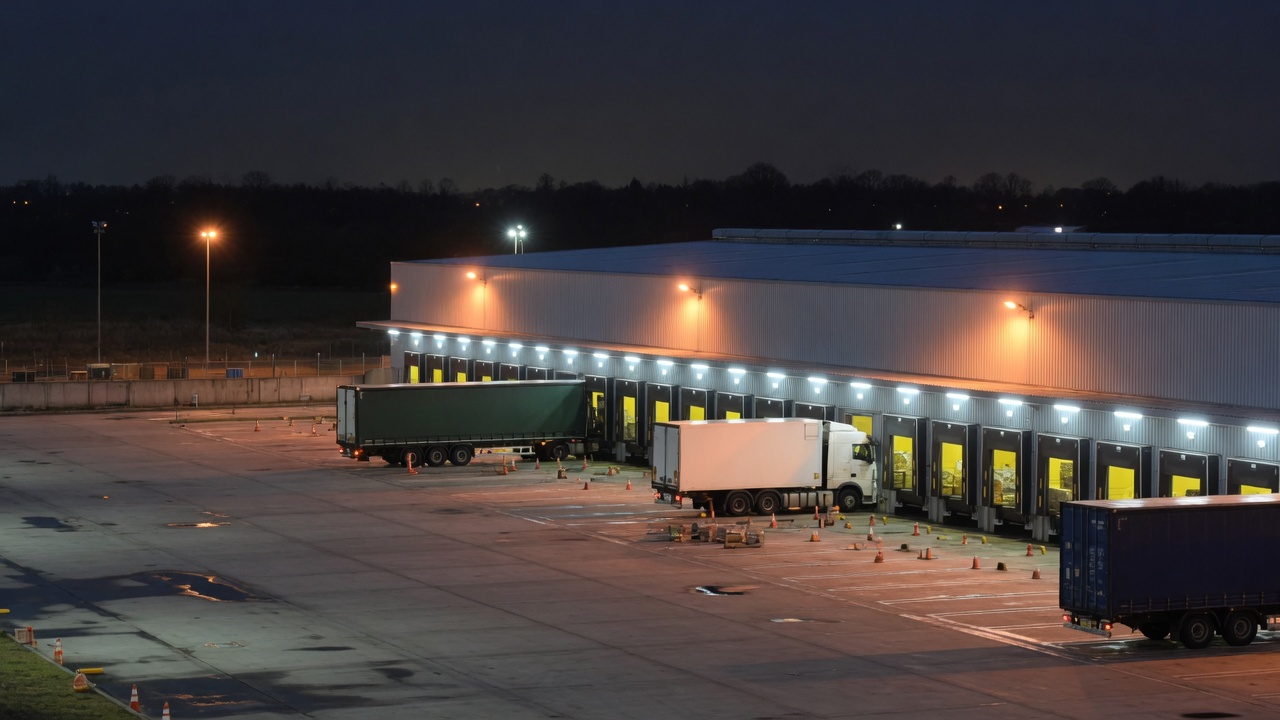
A warehouse at 3 a.m. is doing what a forest does not: running the day on purpose in the dark. Packages move because someone clicked yesterday. The hidden force is not the cardboard. It is a clock imposed on bodies that evolved for a sun, and a dome of light imposed on insects and birds that still migrate by a sky.
This is not a morality play about shoppers. Same-day delivery is a demand signal. Signals get answered. The people who answer them at 3 a.m. are not a metaphor for consumption. They are a labor market, a sleep schedule, and, on the edge of town, a new kind of sky.
What IARC actually classified
In June 2019 a working group of twenty-seven scientists from sixteen countries met at the International Agency for Research on Cancer in Lyon to re-evaluate shift work. IARC, which is part of the World Health Organization family, had classified “shift work that involves circadian disruption” as Group 2A—probably carcinogenic to humans—in 2007. The 2019 meeting, published as a summary in The Lancet Oncology that July and as IARC Monographs Volume 124 in 2020, kept the Group 2A classification and changed the name of the agent to “night shift work.” The new name was chosen to match the exposure that the human studies had actually measured, and to include transmeridian air travel.
The current classification, which has not been superseded, is therefore this: night shift work is probably carcinogenic to humans (Group 2A).
The evidence ladder matters, because Group 2A is not Group 1. The working group found limited evidence in humans: positive associations with cancers of the breast, prostate, colon, and rectum, stronger in some case–control studies with better exposure assessment, inconsistent in cohort studies. Chance, bias, and confounding could not be ruled out with reasonable confidence. It found sufficient evidence in experimental animals for the carcinogenicity of alteration in the light–dark schedule. It found strong mechanistic evidence in experimental systems—immunosuppression, chronic inflammation, cell proliferation—and only suggestive evidence of altered estrogen homeostasis in women who work nights.
IARC’s own questions-and-answers document is careful in a way that headlines are not. A classification is a statement about the strength of evidence that an agent can cause cancer, not a statement about how large the risk is in a particular warehouse, on a particular shift, for a particular person. About one in five workers, in IARC’s global estimate, does some form of night work; definitions and data quality vary. The common sectors are health care, manufacturing, transport, retail, and services. Fulfillment and last-mile logistics sit in that last cluster. They are not a separate biology. They are a growing way of asking the same biology to stay awake.
The 2007 evaluation had used the phrase “shift work that involves circadian disruption.” The 2019 working group dropped that wording because the human studies were, in the main, studies of night work, not of a laboratory construct called circadian disruption. The biology is still the point. Melatonin is suppressed by light at night. Sleep is truncated and displaced. Eating, blood pressure, and immune timing follow a clock that the roster has set against the sun. Those mechanisms are why animal experiments that alter the light–dark schedule can produce tumors, and why the working group treated that evidence as sufficient in animals. They are also why a Group 2A classification can sit beside inconsistent human cohorts without being a contradiction. Hazard identification is not risk quantification. A nurse on a rotating roster and a picker on a permanent night shift are not the same exposure. IARC did not pretend they were.
Sleep is not a preference
Long before the cancer classification, occupational medicine had a more ordinary file: people who work when the rest of the city is asleep sleep less, sleep worse, and carry the consequences in systems that are not the breast.
Charles Czeisler, writing in Nature in 2013, put the precipitating technology where it belongs. The electric light, not a sudden loss of character, is what made a 24-hour society possible. Light is a stronger circadian signal than any drug. Czeisler cited then-current figures: about 30 percent of employed U.S. adults, and 44 percent of night workers, reporting fewer than six hours of sleep; the Institute of Medicine’s estimate that 50 to 70 million people in the United States live with sleep disorders or sleep deficiency, with associations to obesity, diabetes, heart disease, depression, and stroke. He noted IARC’s listing of night work among probable carcinogens. He did not need a popular book to make the mechanism legible. The eye is an organ of timekeeping as well as of sight. Photons at the wrong hour are a schedule.
A 2021 meta-analysis in Sleep Medicine by Fuxiang Su and colleagues pooled sixteen cohorts and nearly a million participants. Night work, compared with day work or with never having done night work, was associated with higher all-cause mortality (pooled relative risk 1.06) and higher cardiovascular mortality (1.15). Cancer mortality sat near 1.04. Heterogeneity was moderate to high. These are not huge relative risks. They are also not zero, and they sit on top of a base of cardiovascular disease that is already the ordinary killer of industrial countries.
Short sleep, rotating schedules, eating at the wrong circadian hour, and reduced daylight after a night shift are bundled in real jobs. Epidemiology is bad at unbundling them. A fair reading is that night work is a package of insults to a timing system, that cardiovascular associations are better supported than a completed story about any single cancer site, and that “probably carcinogenic” is a hazard identification, not a death sentence printed on a time clock.
Rotating shifts are, in many studies, harder on the clock than a stable night roster, because the body never finishes adapting. Permanent nights are still nights. The distinction matters for a warehouse manager who can choose a schedule; it does not rescue the biology of being awake when melatonin would otherwise rise. Eating at 3 a.m. is not a lifestyle brand. It is a metabolic event at the wrong hour, stacked on reduced daylight the next morning for anyone who must sleep through the sun.
What the literature does not support is a cartoon in which eight hours is a sacrament and six hours is a private catastrophe. Sleep duration and mortality often show a U-shape; very long sleep is also associated with worse outcomes, in part because illness lengthens time in bed. Popular books have overclaimed. The occupational file does not need the overclaim. Shift workers are not failing to want rest. They are being paid to be awake in the biological night.
The campus as a light source
A fulfillment campus is a lighting project that happens to ship goods.
Yards, aprons, and trailer courts are lit for safety, cameras, and the geometry of a forklift. The same photons that make a dock usable leak into a sky that nocturnal insects, migrating birds, and nearby bedrooms still have to use. Conservation biology and occupational medicine rarely share a byline. The campus is where they meet: LED and leftover sodium, backup beepers, a circadian system asked to digest lunch at the wrong hour.
Artificial light at night is an established ecological pressure. Many species evolved with a reliable dark. Unshielded fixtures throw light into treetops and into the sky, where it becomes skyglow. Christopher Kyba and colleagues, using the first calibrated satellite radiometer designed for night lights, reported in Science Advances in 2017 that Earth’s artificially lit outdoor area grew by about 2.2 percent per year from 2012 to 2016, with radiance up about 1.8 percent per year. Continuously lit areas brightened at 2.2 percent per year. The “lighting revolution” of LEDs had been sold as an energy saving. The satellite record was not consistent with a global dimming. Cheaper light is used more, and used in more places.
Citizen-science star counts later suggested that the naked-eye sky is brightening faster than the satellite series, on the order of 10 percent per year in some analyses, in part because the satellite instrument is relatively insensitive to blue wavelengths and to light thrown sideways—the two things white LEDs and façade lighting do well. Kyba and co-authors reported that result in Science in 2023. Warehouses are not the whole of that trend. They are a concentrated, industrial version of it, often sited on cheap land at the edge of a metro, which is also where a dark-adapted landscape used to begin.
Insects that navigate by lunar light, birds that move at night to avoid heat and predators, and the ordinary moths that die against a lamp are users of darkness. They were not consulted when a field became a dock. A review in Biological Conservation by Avalon Owens and colleagues has treated artificial light at night as a plausible contributor to insect declines, acting through development, movement, foraging, reproduction, and predation—not as a sole cause, and not as a substitute for pesticides and habitat loss. Migratory birds stall in the glow of towers and glass; that literature is older than fulfillment. The campus is a new, bright patch in an already brightening map.
Flying River will not pretend that a single campus is a mortality statistic for a bird population, or that every lumen on a trailer court is optional. Collision, theft, and injury are real. The design question is the same one that street lighting has already had to learn: put the light on the task, shield it, choose a warmer spectrum where a task allows, and stop treating the rest of the sky as vacant. A dock does not need to illuminate a cornfield. A 24-hour operation does not need to look, from a ridge, like a small city that has forgotten dusk.
Human cardiovascular research has begun to treat night light as more than a nuisance. A 2025 cohort analysis in JAMA Network Open, using personal light sensors, found higher risks of several cardiovascular outcomes among people with the brightest nights, consistent with earlier satellite studies of outdoor night light and with the higher cardiometabolic risk already observed in rotating shift workers. Association is not a completed mechanism in that paper. It is a reminder that the warehouse’s glow is not only an ecological leftover. It is part of the same photon schedule that IARC put in Group 2A.
Same-day as a signal
Retail did not invent the night. Hospitals, steel, ports, and long-haul trucks were awake long before a parcel could be promised by tomorrow. What changed is the conversion of household impatience into a standing operational requirement.
Same-day and next-day delivery are not a moral failing of people who work and parent and cannot wait a week for a part. They are a product attribute that firms compete on, that platforms advertise, and that warehouses, vans, and air hubs then have to staff. Once the promise is ordinary, 3 a.m. is not a surge. It is a shift. The click is a demand signal. The night roster is the supply response.
The campus is only the brightest node. A parcel that leaves a lit bay at 3 a.m. still has to meet a van, a sort facility, sometimes a night flight. Last-mile contractors inherit the clock. So do the streets that take the vans at dawn. The transfer does not stop at the warehouse fence. It is a chain of biological nights, some of them in a building with a time clock, some of them in a driver’s seat, some of them in a bedroom that faces a yard lamp. Shielding the yard and stabilizing the roster are different interventions. Both are about the same transfer.
Labor economics is blunt about what happens next. Night work pays a differential because it is disliked. Turnover in warehousing is high. Temporary agencies fill troughs. The health literature above is the long-run invoice of a schedule that the wage differential only partly prices. None of that requires the shopper to be a villain. It requires the promise to be visible as a transfer: from the customer’s afternoon to someone else’s biological night, and from a dark lot to a lit one.
If you follow the connection from a purchase button far enough, you do not have to stop being a customer. You do have to see that “free overnight” was never free. It was priced in a person standing in a lit bay, and in a sky that is no longer empty. Redesign is possible—stabler shifts rather than rotating ones, genuine rest between nights, darker yards, slower default promises, a premium for urgency that is paid rather than hidden. Those are industrial and retail choices. They are not a sermon at the checkout.
The cynic will say that logistics will always need a night. That is true for some flows: perishable medicine, a hospital’s own shift, a port that meets a tide. It is less true for a household’s non-urgent goods. The difference is the point of a demand signal. Signals can be turned down. A two-hour delivery window is a decision to staff the small hours. A three-day window is a different decision. Neither is nature.
Two literatures, one loading dock
Occupational medicine already knows a good deal about shift work and sleep. Conservation biology already knows a good deal about artificial light at night. Public-health researchers have spent decades on short sleep and the cardiovascular system. IARC has spent two monograph cycles on the cancer question and has left it in Group 2A, which is an honest place to leave a probable hazard with inconsistent human epidemiology.
The warehouse at 3 a.m. is where those files share a building.
Established: night work disrupts sleep and circadian timing; the disruption is the main physiological fact IARC named; light at night is a circadian signal and an ecological one; fulfillment’s growth has made a particular kind of industrial night more common. Probable: that the package of night work raises long-run health risks, including some cancers, in the sense IARC uses that word. Unknown, or at least not something a magazine should fake: how much any one campus contributes to a regional insect decline, how to divide a gram of risk among a shopper, a platform, and an employer, and which lighting and scheduling reforms cut harm without simply moving it to another contractor.
The editorial temptation is to end with a finger. The systems fact is colder. Convenience is a transfer. Transfers can be priced, slowed, shielded, and staffed with more respect for the organ that keeps time. They will not be abolished by guilt. They will also not become natural by being ordinary. A forest at 3 a.m. is dark because the sun is down. A warehouse at 3 a.m. is bright because a promise was made. The promise is the part that can be rewritten.
Sources
- Straif, Kurt, et al. (IARC Monographs Working Group). “Carcinogenicity of Shift-Work, Painting, and Fire-Fighting.” Lancet Oncology 8, no. 12 (2007): 1065–1066. (Group 2A for shift work involving circadian disruption.)
- IARC Monographs Vol. 124 group. “Carcinogenicity of Night Shift Work.” Lancet Oncology 20, no. 8 (2019): 1058–1059.
- International Agency for Research on Cancer. Night Shift Work. IARC Monographs on the Identification of Carcinogenic Hazards to Humans, Vol. 124. Lyon: IARC, 2020.
- International Agency for Research on Cancer. “IARC Monographs Meeting 124: Night Shift Work. Questions and Answers.” 5 July 2019.
- International Agency for Research on Cancer. “IARC Monographs Volume 124: Night Shift Work.” 2 June 2020. (Group 2A: probably carcinogenic to humans; limited human evidence for breast, prostate, colon, and rectum.)
- Czeisler, Charles A. “Perspective: Casting Light on Sleep Deficiency.” Nature 497 (2013): S13.
- Institute of Medicine. Sleep Disorders and Sleep Deprivation: An Unmet Public Health Problem. Washington, DC: National Academies Press, 2006.
- Su, Fuxiang, Ding Huang, Hongyu Wang, and Zhiyong Yang. “Associations of Shift Work and Night Work with Risk of All-Cause, Cardiovascular and Cancer Mortality: A Meta-Analysis of Cohort Studies.” Sleep Medicine 86 (2021).
- Kyba, Christopher C. M., et al. “Artificially Lit Surface of Earth at Night Increasing in Radiance and Extent.” Science Advances 3, no. 11 (2017): e1701528.
- Kyba, Christopher C. M., Yiğit Öner Altıntaş, Constance E. Walker, and Mark Newhouse. “Citizen Scientists Report Global Rapid Reductions in the Visibility of Stars from 2011 to 2022.” Science 379, no. 6629 (2023): 265–268.
- Windred, Daniel P., Angus C. Burns, Martin K. Rutter, et al. “Light Exposure at Night and Cardiovascular Disease Incidence.” JAMA Network Open 8, no. 10 (2025): e2539031.
- Owens, Avalon C. S., et al. “Light Pollution Is a Driver of Insect Declines.” Biological Conservation 241 (2020): 108259.
Convenience is a transfer. The night shift is where the transfer lands.
Follow the connection
- Same-day demand
- Night warehouse
- Light and shift work
- Sleep debt
- Health and skyglow
What we know
- Night and rotating shift work are associated, in a large occupational-health literature, with sleep disruption and elevated long-term health risks.
- Warehouses and yards are bright, loud, and timed to delivery promises, not to sunrise.
- The same light that makes a dock safe leaks into a sky that nocturnal wildlife still has to use.
- Consumer same-day expectation is a demand signal that makes 3 a.m. ordinary.
What remains uncertain
- How to divide responsibility among shoppers, platforms, and employers without a morality play.
- Which lighting and scheduling reforms cut harm without simply moving it.
- Local ecological effects of a particular fulfillment campus.
What can we do?
You don't have to care about this because everyone else does. You can care because the evidence gives you a reason to.
- Notice that a two-hour delivery is a night somewhere.
- Support scheduling, pay, and lighting rules that treat sleep as infrastructure.
- Shield outdoor campus lighting the same way a street should be shielded.
Demonstration authors are fictional. The phenomena discussed are real subjects of public scientific literature and reporting. Sources named in the article are documented; this is not a comprehensive literature review.